Oct 07, 2026
Analysis of the 2026 BC Budget: We Can No Longer Ignore the Ageism at its Core
The BC government says its 2026 budget safeguards essential services. But a closer look at the numbers reveals a troubling pattern: the province is working far harder to protect spending that benefits residents of retirement age than to invest in younger residents — all while leaving younger people with massive unpaid bills.

Andrea Long
/February 17, 2026
The BC government says its 2026 budget safeguards essential services. But a closer look at the numbers reveals a troubling pattern: the province is working far harder to protect spending that benefits residents of retirement age than to invest in younger residents — all while leaving younger people with massive unpaid bills.
At the heart of this imbalance is a long-standing failure to plan for population aging and its predictable impact on medical spending. That failure becomes impossible to ignore when we follow the money.
According to Budget 2026, medical care will receive another $3.2 billion in new annual funding by 2028 — more than double the $1.4 billion added to K-12 education, child care, trades training, and social services combined.
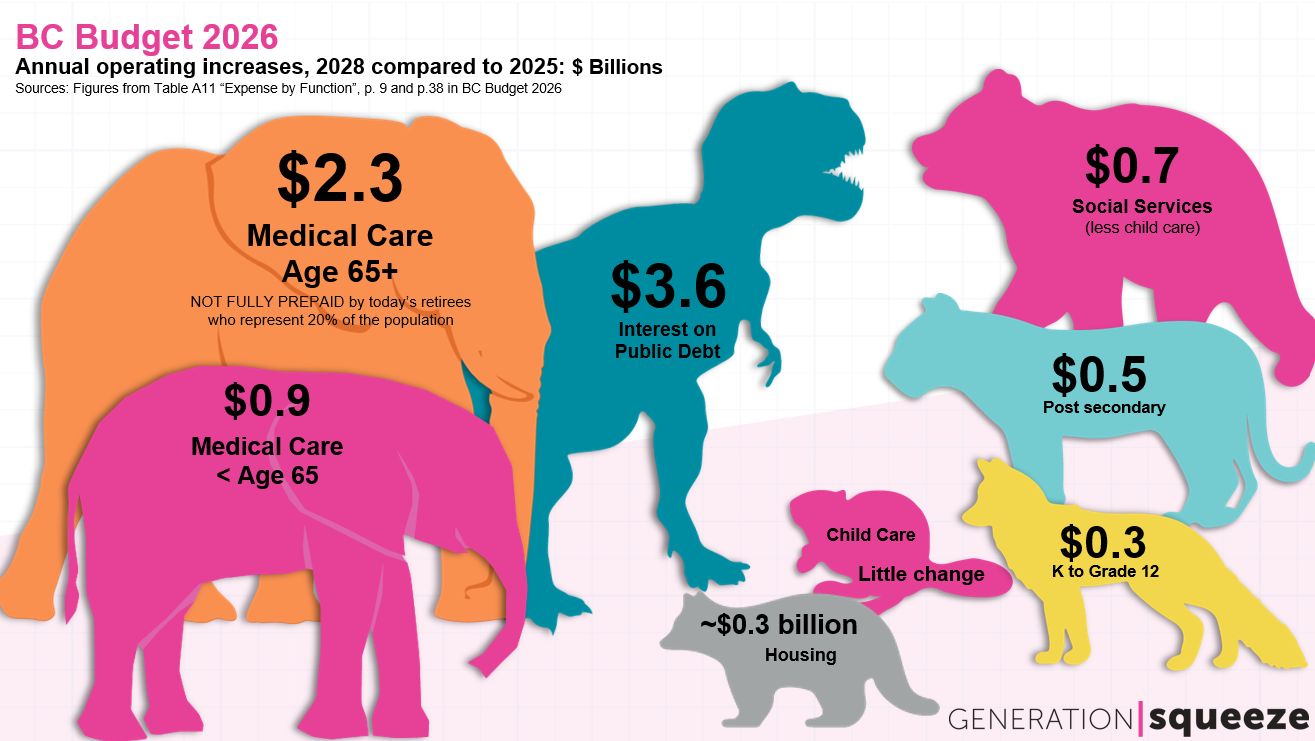
The Canadian Institute for Health Information consistently reports that Canadians aged 65 and over consume roughly four times as much medical care than those under age 50. When this age-based cost pattern is applied to B.C.’s aging population, the implication is that about 70 per cent of the new medical funding — roughly $2.3 billion — will go to seniors.
Adjusting the full budget for BC’s age distribution tells an even starker story. The 2026 budget adds about $2,100 in new annual spending per retiree (mostly through medical care), compared with roughly $440 per resident under age 45. Younger people make up most of the population, yet receive only a small share of new funding, because investments in their priorities — child care, K-12, postsecondary education, and housing — are so limited.
The result is clear. BC is working roughly five times harder to prioritize spending for retirees than for younger residents.
That is difficult to interpret as anything other than structural age bias — a far cry from the government’s strategic plan promise just two years ago of “a B.C. that keeps working for all generations.”
The Deficit Younger Generations Will Pay
The age imbalance in the 2026 Budget looks worse when you factor in the deficit. The province forecasts a record $13.3-billion deficit for the coming fiscal year, following what was already projected to be a record $9.6-billion shortfall in 2025. Deficits are expected to remain near record levels for several more years.
The Premier’s own Deputy Minister has publicly acknowledged that this level of deficit is “unsustainable.” Yet the budget makes no serious effort to reduce it.
Deficits are not abstract numbers. They are unpaid bills. And those bills fall disproportionately on younger and future generations who will inherit them.
Yes, the Budget includes modest tax increases: about $400 million a year from a small increase to the lowest income tax rate (offset for low-income earners), plus roughly $500 million from frozen tax brackets, and another $500 million from extending PST to some professional services.
Property taxes on homes valued above $3 million are also rising, and the government will fix the property tax deferral program by ending its indefensibly low interest rate for homeowners who delay paying. Together, these welcome housing-related changes will raise about $170 million a year.
These are sensible steps. But together, they barely dent the deficit. And that’s why interest on the provincial debt is now growing faster than education, social services, and housing combined.
The Real Driver of Spending Growth
The 2026 budget (p. 14) acknowledges that BC’s fiscal outlook is challenged by growing demand for medical services, “driven by an aging population with more complex needs, and compounded by the continuous rise in physician compensation.” Explicitly admitting this is a start. But the government remains silent on a deeper truth.
Governments knew this wave of population aging was coming, and they knew the fiscal pressures it would create. Yet for decades, they chose not to prepare revenue systems to pay for the entirely predictable costs of baby boomers aging into high-use medical years.
In the 1990s, Ottawa reformed the Canada Pension Plan (CPP). CPP premiums were increased by roughly 68 per cent so boomers would pre-fund a substantial share of their retirement benefits. Provinces made no comparable reforms for medical care.
We can now calculate the consequences of this failure using CIHI’s age-specific medical spending data, building on Gen Squeeze’s recent study. The latest numbers show if BC still had just 10 per cent of its population over age 65 as was the case when baby boomers were young — instead of roughly 20 per cent today – nearly all of the 2025 deficit would disappear, even if nothing else in the budget changed. That single demographic shift explains about $8.5 billion of B.C.’s $9.6 billion in red ink.
BC’s failure to plan for population aging now shows up in every budget because the resulting underfunding produces three interrelated problems:
- Persistent frustration with access to family doctors and emergency care, which are often mischaracterized as simple “doctor shortages” even though BC has far more physicians per capita than decades ago.
- Growing fiscal demands on younger taxpayers.
- Slower investment in the foundations of long-term health — child care, education, housing, and poverty reduction.
Around 1976, when boomers were young, provinces routinely spent more on social services and education than on medical care. Today the opposite is true. Medical care dominates budgets, crowding out investments that prevent illness in the first place. This creates a vicious cycle: underinvestment in prevention increases future health demand, which deepens fiscal pressure, which further squeezes social spending.
Breaking the Silence
No BC government — regardless of which party leads it — will have any chance of balancing the budget until we speak honestly about the main driver of our current deficit: the collective failure to pre-fund the predictable costs of population aging.
Instead, we quietly shift the burden onto younger British Columbians. They already contribute 17 to 33 per cent more of their income taxes toward financing healthy retirements than boomers did at the same age. Now they are also asked to absorb record deficits.
Calling this “ageism” may feel uncomfortable. But when a budget systematically expands spending linked to retirees five times more than for younger residents — while leaving the bill unpaid — it is hard to call it anything else.
The solution is not to pit generations against one another, as this year’s budget effectively does. It is to modernize revenue systems so aging costs are financed fairly and transparently, in proportion to how those costs fall across generations — just as the Canada Pension Plan was modernized in the 1990s.
Until we confront that failure, deficits will stay high, pressure on physicians will intensify, and investment in prevention and opportunity will fall behind. We will keep insisting we are safeguarding essential services — when in reality we are safeguarding one essential service for our aging loved-ones, while neglecting the rest.
About Andrea Long
Andrea is the Senior Director for Research and Knowledge Mobilization at Generation Squeeze.
Get Updates
*By clicking "Sign up", you consent to receive periodic updates from Generation Squeeze by email, text and/or phone. You can unsubscribe or text STOP at any time. Message and data rates may apply. Read our privacy policy.
Search
Latest posts
Oct 06, 2026