2026 Alberta Budget: A deficit driven by population aging, not just population growth
Premier Danielle Smith largely attributes Alberta's record $9-billion deficit to population growth. She's right to focus on demographics, but by concentrating on a population headcount rather than population aging, she misdiagnoses the source of fiscal strain. The result is a Budget that discriminates against children, parents, and young workers.

Failure to address this makes Budget 2026 anti-child, anti-parent and anti-young worker
Premier Danielle Smith largely attributes her record $9-billion deficit in Budget 2026 to rapid population growth. She is right to focus on demographics, but by concentrating on a population headcount rather than population aging, she misdiagnoses the source of Alberta’s fiscal strain. The result is a budget that discriminates against children, parents, and young workers.
Rising medical care costs for an aging population drive Alberta’s deficit
The Canadian Institute for Health Information documents how medical spending rises steeply with age: roughly $3,000 a year for each person under 50, about $10,000 by age 70, and nearly $37,000 by age 90. Each Albertan aged 65 and over uses as much medical care as four residents under 50.
This trend matters, because Alberta has grown substantially older over the last half century. In 1976 when baby boomers were young, just 7 per cent of the province was over age 65. Today that share has more than doubled to 15 per cent.
Alberta’s population is roughly 160 per cent larger than it was in 1976: 5.03 million today compared with 1.87 million in the mid-1970s. But because the share of seniors has also doubled – and seniors use roughly four times as much care as younger residents – demand for medical care has surged by more than 230 per cent. Population growth alone cannot explain the cost pressures now confronting the province.
The fiscal implications are enormous. If Alberta still had just 7 per cent of its population aged 65 and over — rather than 15 per cent — the province would spend over $6 billion less this year on medical care, without changing anything else in its budget. These aging-related costs account for roughly two-thirds of the historic deficit tabled this year by the Smith government.
This makes Alberta’s deficit structural, not just cyclical – and certainly not simply a reflection of recent immigration.
Alberta’s deficit is a byproduct of the failure to prepare for the predictable cost increases
Decades ago, governments knew population aging would drive higher medical costs. Unlike Ottawa’s reforms to the Canada Pension Plan in the 1990s which increased premiums by 68 per cent to help prefund boomers’ retirement benefits, Alberta did not modernize its revenue system to prepare for rising health expenditures. The province made no comparable effort to build surpluses that boomers would later draw down as their use of medical care increased.
The result is an intergenerational transfer embedded in fiscal policy. Younger Albertans now contribute 20 to 40 per cent more of their income taxes toward seniors’ medical care and benefits than boomers did at the same age. Millennials and Gen Z are effectively subsidizing their aging loved ones’ retirements even as they face far higher housing costs and greater financial insecurity than earlier generations – especially as provincial housing costs continue to rise.
Alberta’s response should be to launch a “Better Late Than Never” task force to design a generationally fair financing plan for medical care that protects vulnerable seniors, stabilizes provincial finances, and reduces the disproportionate burden now placed on younger generations. Without a modernized approach, the province will sustain chronic deficits, patients will endure longer wait times, and other priorities will continue to fall victim to under-investment.
Instead of following this path, Budget 2026 misidentifies population growth — particularly immigration — as the primary driver of demographic change. That error distorts spending priorities in ways that disproportionately harm younger Albertans.
Growth in medical care spending squeezes preventive investments in wellbeing
The province embraces large deficits in order to pour more money into a medical system that already spends more per person than in B.C. and Ontario, without consistently achieving better health outcomes.
Escalating medical spending includes increased compensation for physicians, even though Alberta’s doctors are already the best paid in the country. CIHI data confirm that the higher pay offered by Alberta hasn’t put the province on top in terms of number of physicians. The latest numbers show there are 241 physicians per 100,000 Canadians nationally. Alberta has 240 — well behind British Columbia, which leads the country at 271.
While medical spending spirals up, investments in the building blocks for a healthy society are comparatively modest — especially for younger residents. Decades of health research shows that affordable housing, quality child care, poverty reduction, and environmental stability shape health outcomes far more than increases in medical spending.
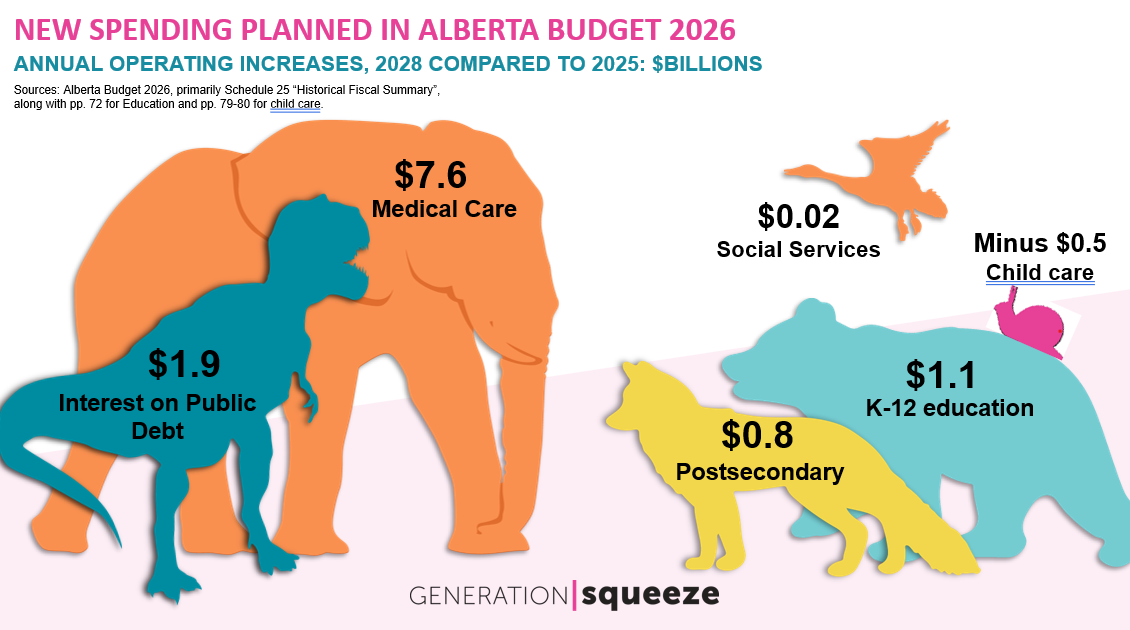
According to Schedule 25 of the Alberta budget, annual medical spending will grow by $7.6 billion by 2028. By comparison, K-12 education rises by $1.1 billion, postsecondary by $0.8 billion, child care falls by $0.5 billion, and other social services increase by just $0.02 billion. Schedule 2024 also shows budget 2026 invests less than one per cent of its total spending on housing.
Structural ageism is at the core of Alberta’s Budget
Because Canadians use far more medical care after age 65 than in their first six and a half decades combined, these provincial investment decisions direct new funding toward retirees over three times faster than younger residents: roughly $4,300 per senior compared to $1,200 per Albertan under age 45. That is structural ageism in fiscal form.
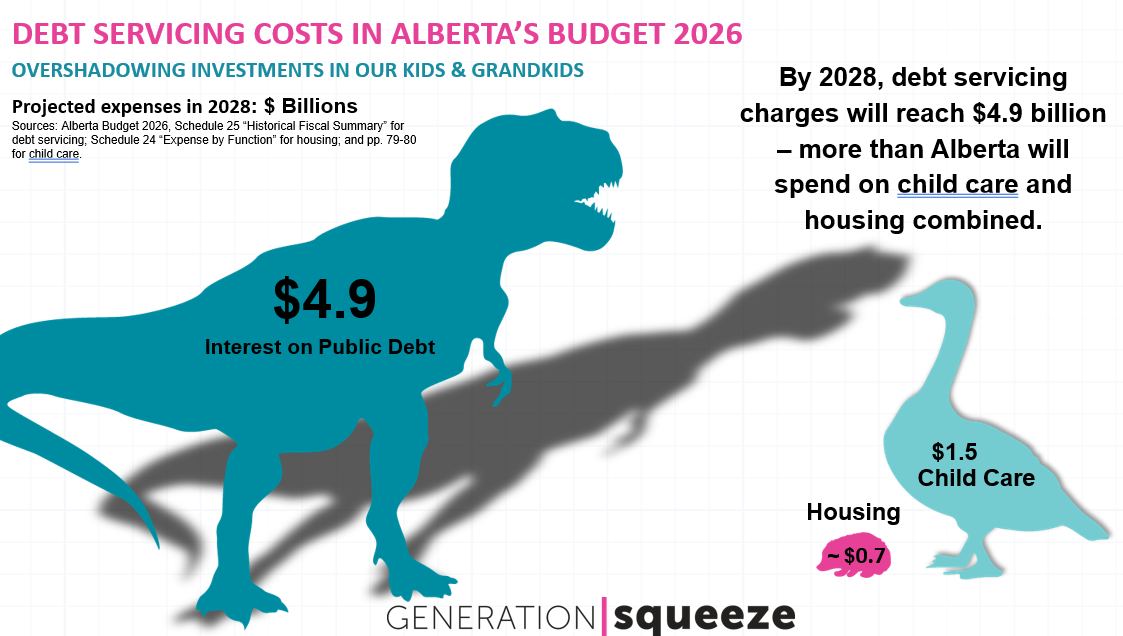
The imbalance is compounded by the decision to incur $24 billion in deficits over the next three years, adding more than $7,000 in public debt for every Albertan under age 45.
Much of this could have been avoided had Alberta’s brand of conservatism not embraced the familiar formula of taxing less while spending more. Premier Smith maintained last year’s income tax cut, reducing the rate on income under $60,000 from 10 per cent to 8 per cent — a measure the government itself estimates costs $1.2 billion annually. Layering permanent tax reductions onto rising age-related costs deepens the fiscal hole.
Until Alberta confronts the demographic reality of population aging — and modernizes its revenue system accordingly — deficits will persist, debt will grow, and younger generations will continue to shoulder the bill.