Boomer Medical Costs Flip Provincial Budgets from Surplus to Deficit
Medical care is the largest expense in every provincial budget. As the population ages, costs have risen sharply - without matching updates to revenue. A new Gen Squeeze study helps Canadians understand what it will take to protect universal access for every generation.

Alberta is proposing new rules that would allow doctors to practice in both public and private settings. Quebec is attempting to require physicians to see more patients. These changes are often framed as responses to doctor shortages — but they reveal something deeper: a surge in demand for medical care as the population ages, a pressure point too often missing from public debate.
Medical care is the largest expense in every provincial budget, yet the system is straining under pressures governments should have seen coming. As boomers age and live longer, the cost of caring for older Canadians has risen sharply — without matching updates to provincial revenue systems.
This mismatch now drives provincial deficits and long wait times, while crowding out investments younger Canadians rely on, from housing to education. It also obliges younger taxpayers to backfill their parents’ and grandparents’ medical bills — predictable pressures governments failed to plan for decades ago.
Despite this, the fiscal impact of population aging is rarely discussed openly or quantified clearly. A new study from the Generation Squeeze Lab brings the evidence together so Canadians can understand what’s at stake and what it will take to protect universal access for every generation.
Download the full study and provincial analyses:
https://action.gensqueeze.ca/medical_budgets_in_an_aging_canada
Listen to our latest podcast on this study:
Data from the Canadian Institute for Health Information show that Canadians under 50 on average use about $3,000 annually in publicly funded care. By the early 70s, average costs exceed $10,000. By age 90, they approach $37,000. A typical senior consumes more care than four Canadians under age 50 combined.
This ratio lets us compare medical demand when boomers were young versus today, accounting for population growth and aging. In 1976, Canada’s 23.5 million people, with only 9 per cent over 64, generated the equivalent medical demand of 32.2 million under-50 patients. By 2024, the population grew to 41.3 million. If the senior share had remained at 9 per cent, demand would equal 56.7 million under-50 equivalents.
But with nearly one in five Canadians now over 64, demand has climbed to 75.6 million. Aging alone added the equivalent of 18.9 million younger patients on top of population growth.
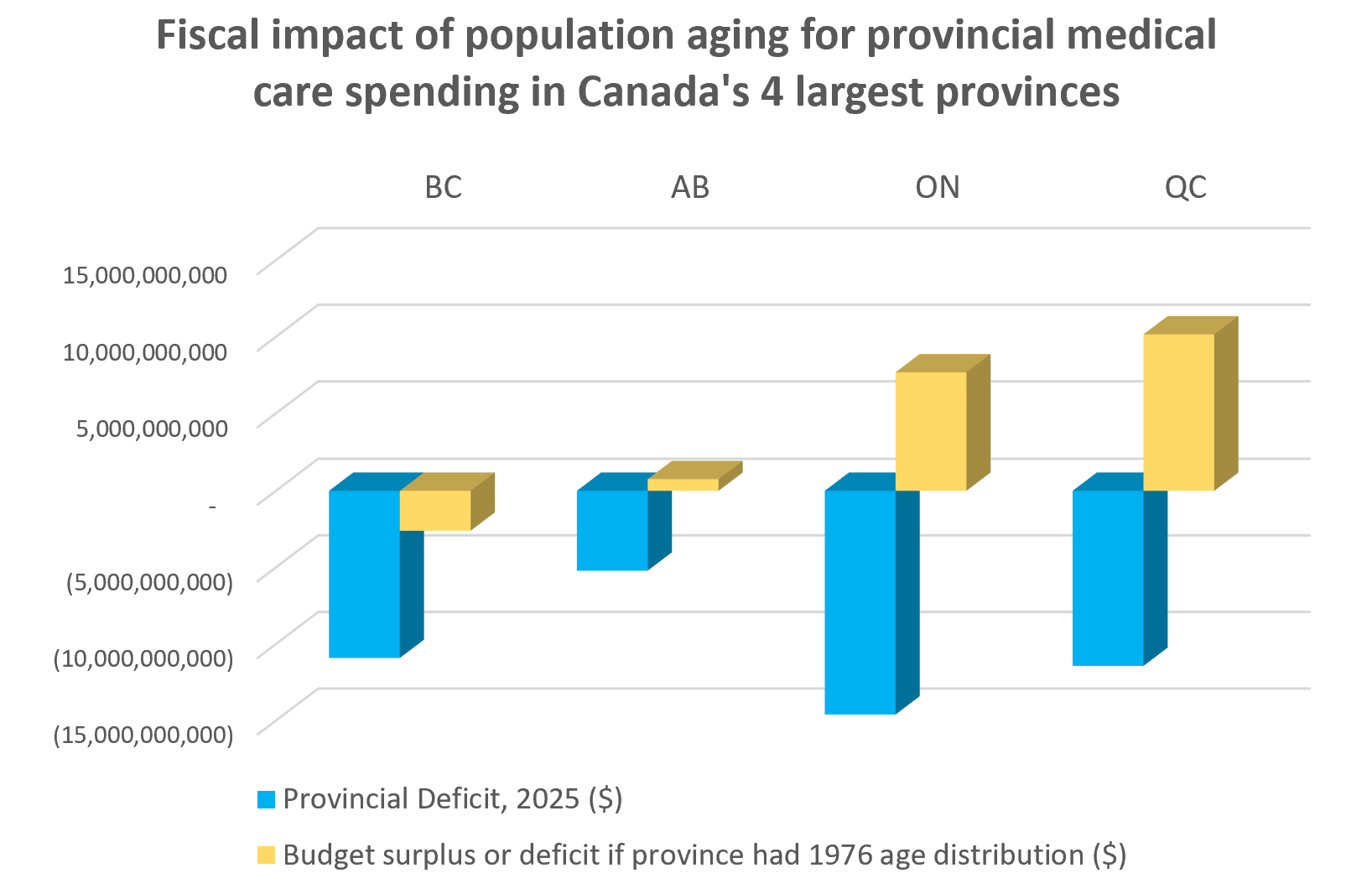
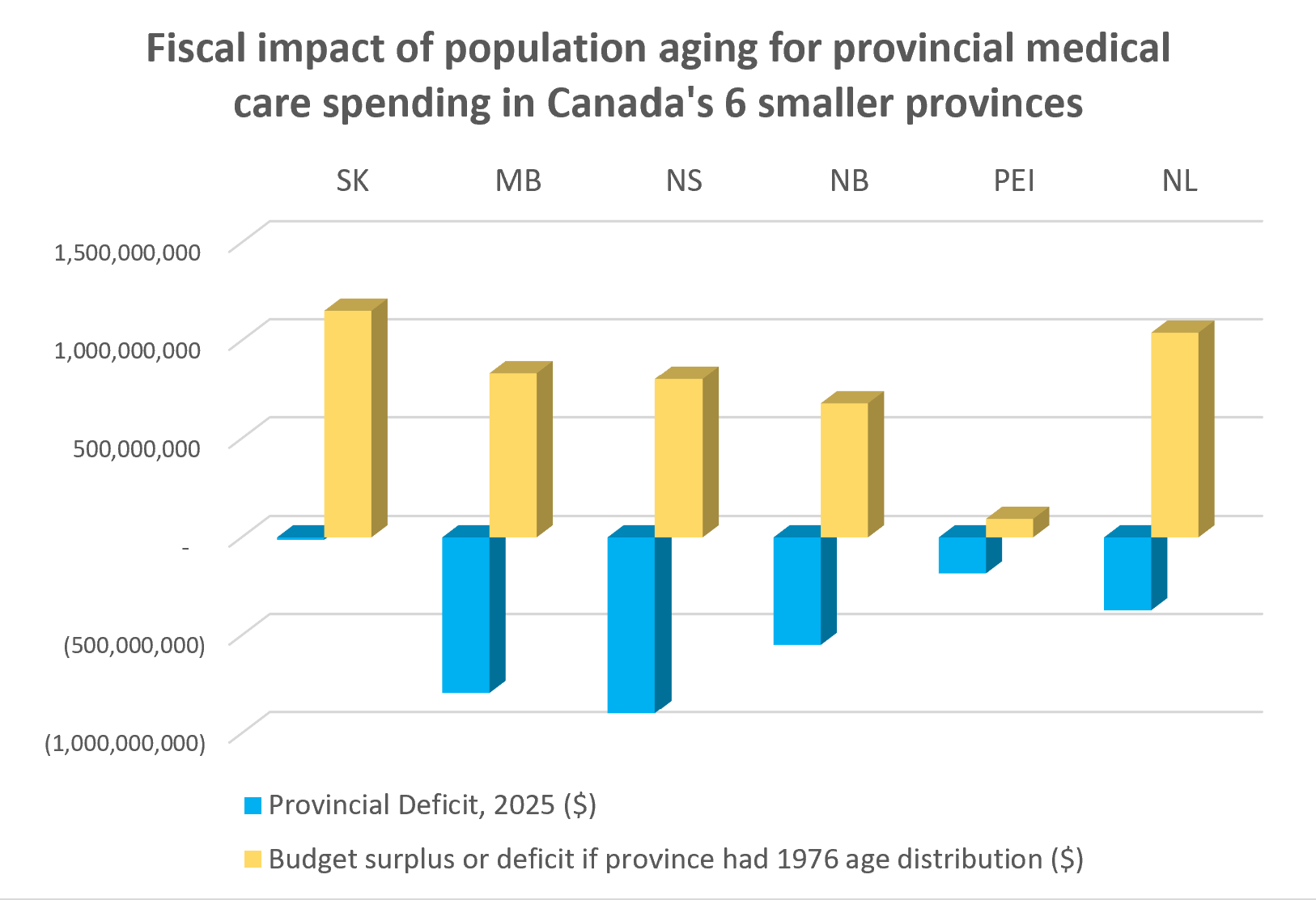
Running these pressures through provincial budgets produces stark results. Holding today’s spending patterns constant but swapping in the 1976 age distribution, most provinces would move from deficit to surplus.
- In Ontario, aging-related medical costs now exceed $22 billion annually — enough to turn a $15-billion deficit into an $8-billion surplus.
- Quebec shows a similar swing: its $22-billion aging cost converts what would have been a $10-billion surplus into the $11-billion deficit planned for 2025.
- If Alberta still had the 1976 age structure, its 2025 budget would flip from a $5.2-billion deficit to a $761-million surplus.
- Smaller provinces follow the same pattern: in Nova Scotia, New Brunswick, PEI and Newfoundland, aging costs more than account for today’s deficits.
- Saskatchewan’s slim $12-million deficit reflects a population that hasn’t aged as sharply.
- B.C. is a partial exception: its per-capita deficit is larger, and aging explains only about three-quarters of the shortfall.
The takeaway is clear: the fiscal footprint of aging now drives provincial balance sheets. Unlike other drivers of deficits, like economic shocks, this one was predictable — and preventable.
None of this is about blaming people for growing old. The failure lies with provincial governments decades ago, which ignored repeated warnings to prepare for boomer medical care, even as Ottawa modernized the Canada Pension Plan so boomers prepaid more for their pensions. That asymmetry is why today’s younger taxpayers already contribute 20 to 40 per cent more of their income taxes to healthy retirements than boomers did at the same age — while earning less (after inflation), paying more for housing, and facing costs of climate adaptation.
Recommendation
Politicians who avoid confronting these demographic pressures aren’t protecting anyone. Without new revenue, provinces will remain stuck in chronic deficits, wait times will grow, and pressure for two-tier care will intensify.
Canada needs to modernize how we fund medical care. That means pairing overdue efficiency reforms with a realistic, generationally balanced revenue plan that matches the predictable cost of caring for an aging population.
We recommend a “Better Late Than Never” federal-provincial-territorial task force to design revenue systems that:
- Protect universal access
- Support seniors’ dignity
- Stabilize provincial finances
- Preserve room for investments that keep people healthy
- Reduce the burden younger Canadians now shoulder
Universal medical care is one of Canada’s proudest accomplishments. Its future depends on leaders having the courage to ask financially secure retirees to contribute a bit more — to protect seniors in need, ease the load on their kids and grandkids, and sustain the system for every generation. If we ignore these realities, frustration about access will harden into resentment, and a legacy Canadians cherish could begin to fray.