New poll: Canadians want to fix retirement income subsidies to tackle affordability
New poll confirms Canadians want to fix retirement income subsidies to tackle affordability. Now it's time for Ottawa to act.


Retired couples with incomes of $185,000 can receive the full $18,000 annual Old Age Security subsidy – and couples with over $300,000 still get some support.
Our new national poll confirms that most Canadians know this no longer makes sense.
Just as they did in 2024, Canadians support responsible OAS reforms that redirect taxpayer funds where they will help the most.
Support is broad. It spans political parties, regions, and income groups — including retirees themselves. This is a rare moment when good policy, public readiness, and fiscal necessity are aligned.
Now is the time for Ottawa to act.
Key Poll Findings
Support for OAS Reform is Strong, Consistent, and Durable
Support for OAS reform isn’t new — and it isn’t fading.
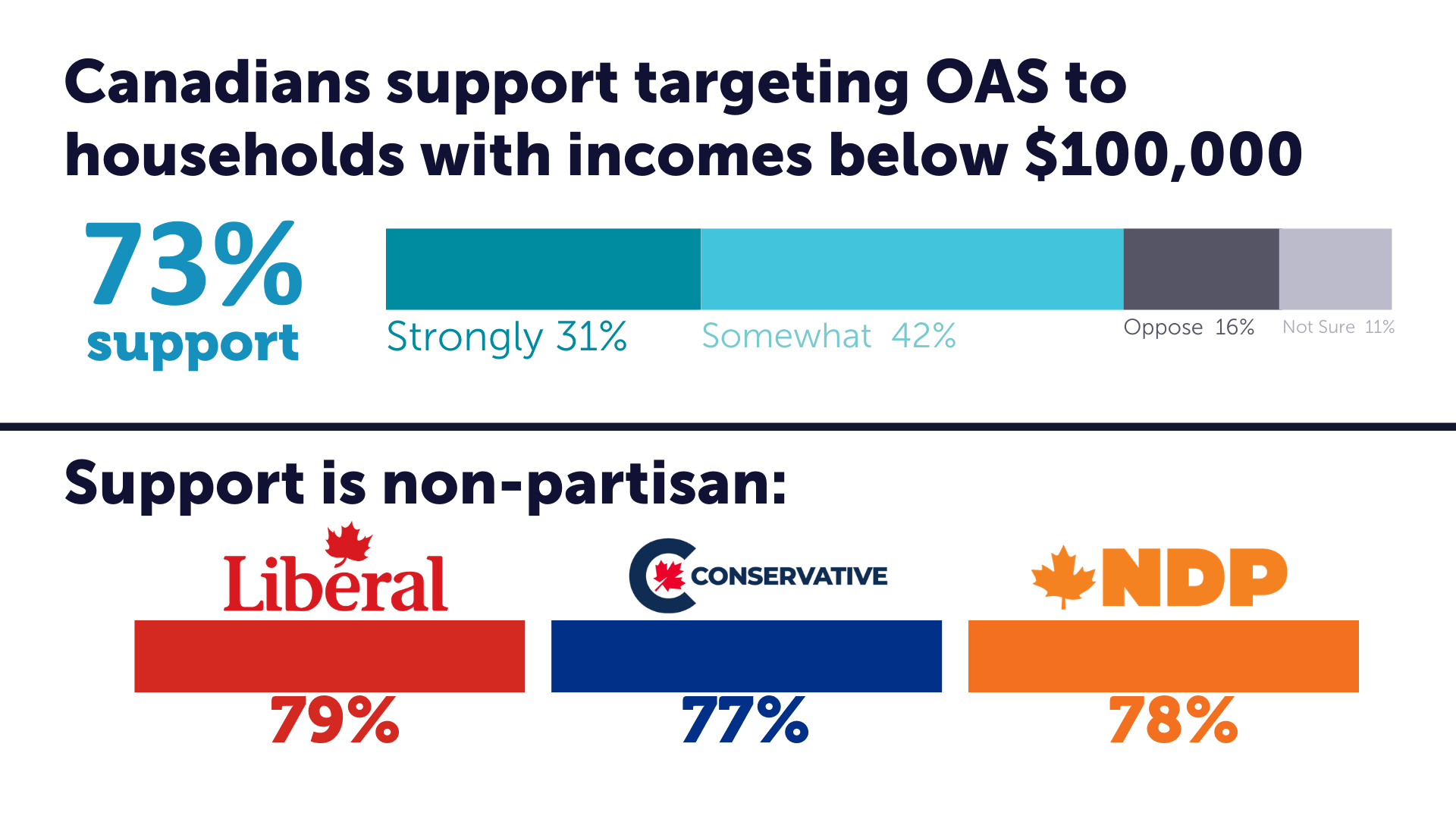
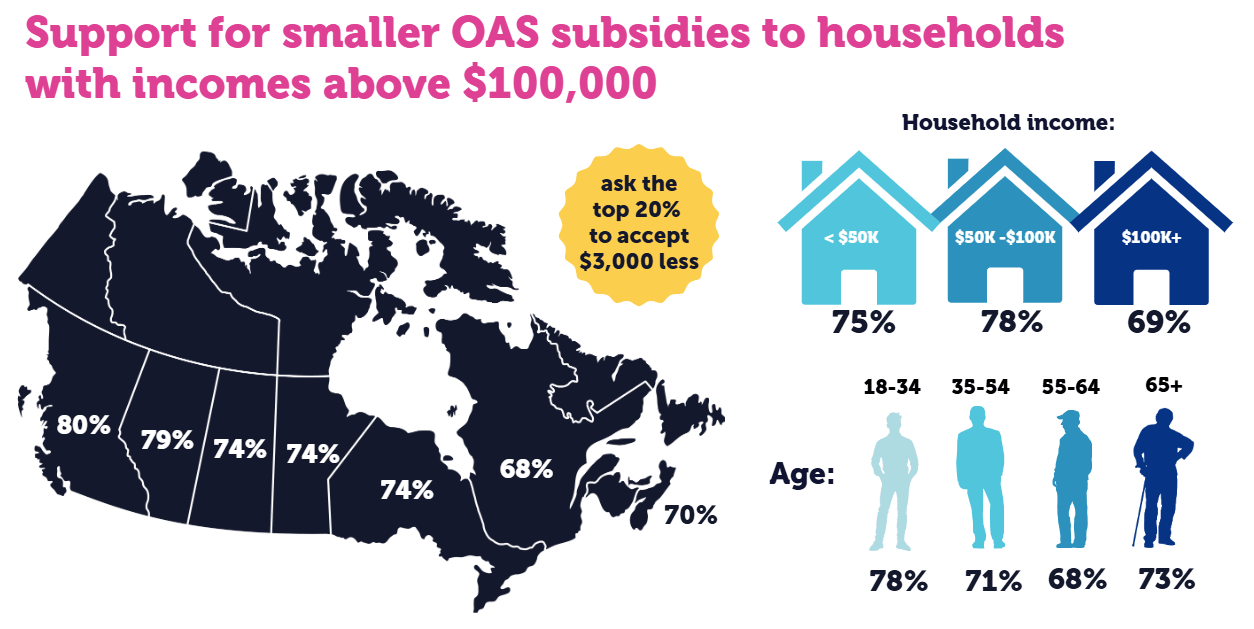
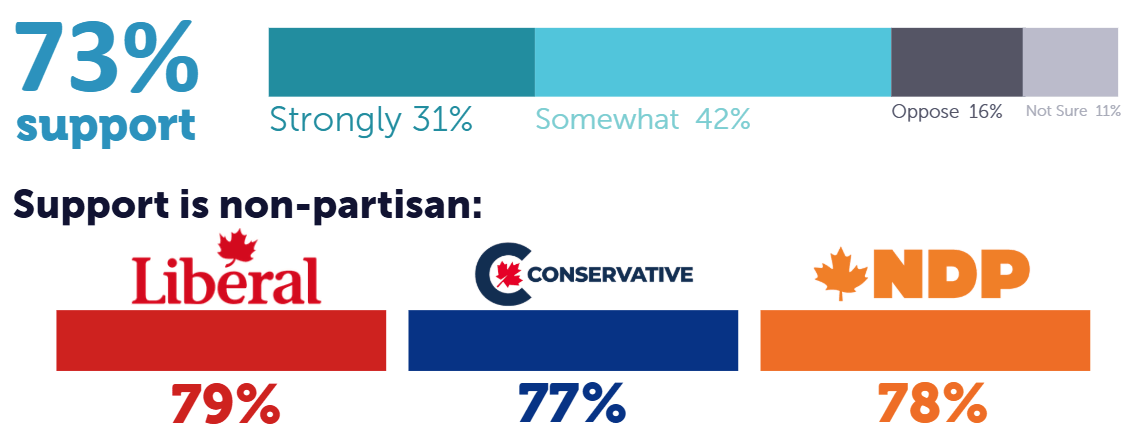
Three quarters of Canadians supported reform in 2024, and three quarters still support it today — including 3 in 4 retirement age Canadians.
Support holds across regions, incomes, and political parties. Roughly 8 in 10 Liberal, Conservative and NDP voters are in favour of making OAS responsible, modern, and fair.
Stable, cross-partisan support over 18 months is rare in public opinion. Ottawa doesn’t need to wonder what Canadians think — it needs to act.
Canadians reject the status quo on OAS
Just 10% of Canadians think OAS should be left as is. The status quo is clearly the least popular option for Canadians.
Most Canadians Support Targeting OAS to Households with Incomes Below $100,000
Three quarters of Canadians agree that Canada should reduce OAS subsidies for retirees with six-figure incomes by lowering the household income eligibility threshold for OAS from $185,000 to $100,000 – so that the $7 billion annual savings can be used to eliminate seniors’ poverty and reduce living costs for younger Canadians.
Canadians understand that households with incomes of $185,000 don’t need more money from taxpayers to cope with rising living costs. We can tackle affordability pressures by better targeting cash subsidies where they will help the most.
Reducing the OAS threshold to $100,000 would ask just 20% of retirees to accept modestly smaller subsidies – about $3,000 after tax on average. For 80% of OAS recipients, benefits would be protected or improved, including for those living alone.
OAS reform isn’t about cuts — it’s about reining in the growth of Canada’s largest program so that we can make real progress on meeting other pressing national priorities. Every dollar sent to high-income retirees is a dollar not available to reduce seniors' poverty or ease cost pressures for young and working-age people.
Many Canadians Want Even Bolder Action
Most Canadians are ready to go even further to make OAS responsible, modern, and fair.
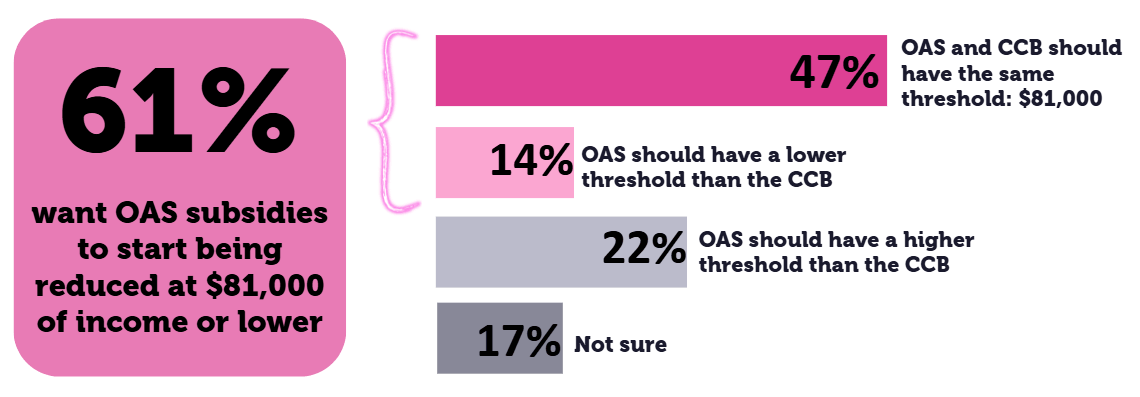
Six in ten agree that the OAS threshold should be the same or lower than the threshold for the Canada Child Benefit – currently set at $81,000. This bold move would increase annual savings from $7 billion to nearly $13 billion.
Clearly public opinion isn’t just supportive — it’s ambitious. Canadians from every region and income group support reducing the OAS threshold to $100,000, to better align eligibility for cash supports across the life course.
Canadians Back Fixing Ineffective Retirement Tax Credits
In addition to fixing OAS, Canadians want Ottawa to improve how other retirement supports are delivered.
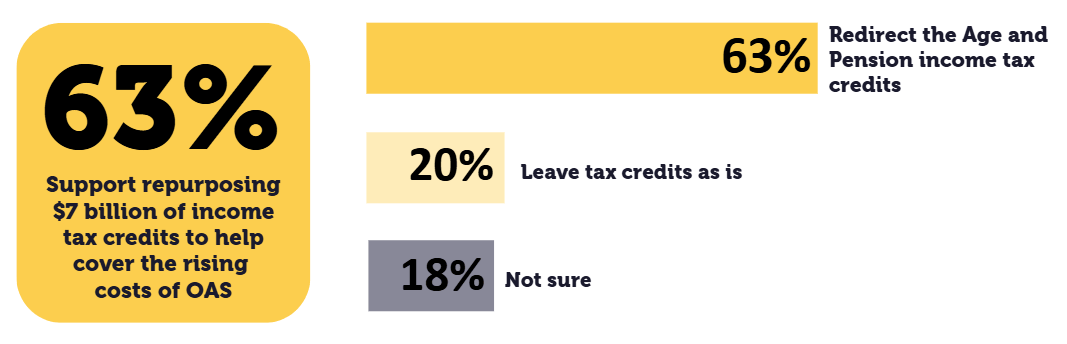
63% support redirecting funds from two poorly designed tax shelters to offset rising OAS costs driven by population aging.
Despite costing taxpayers $7 billion a year, the Age and Pension Income Credits fail to benefit many low-income seniors – a design flaw most no longer want to tolerate. Seniors themselves are most likely to want a remedy from Ottawa: 69% agree that these funds could do more to reduce poverty and manage budget pressures if they were redirected into OAS.
We Can Achieve the Generational Change Canadians Want
Together, the policy reforms Canadians support could generate up to $20 billion in annual savings, without raising taxes or growing the deficit still further.
These changes don’t just fix OAS — they unlock one of the largest opportunities to improve affordability in a generation.
So what can we accomplish together with these funds?
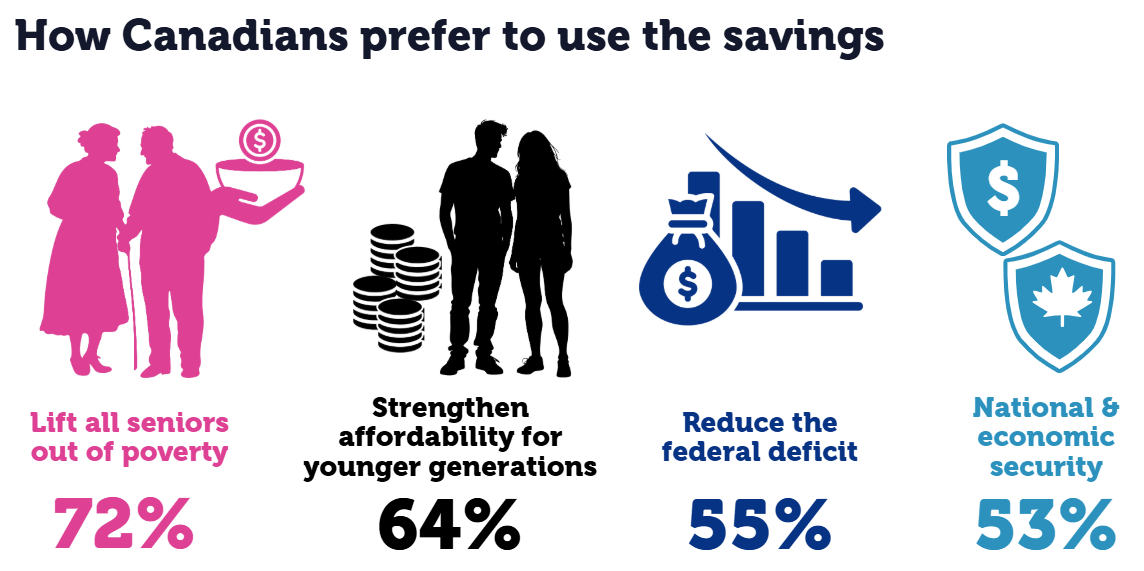
$2.5 billion annually would deliver a $5,000 boost to every senior below the official poverty line – effectively eliminating seniors’ poverty in Canada.
The remaining billions create real choices for Canada — including bold, nation-building investments to improve affordability for young and working-age generations. Opportunities include:
- Strengthening the National Housing Strategy to avoid planned cuts after 2027
- Boosting Canada Student Grants instead of letting them decline
- Accelerating implementation of $10-a-day child care
- Introducing a Youth Employment Supplement to help young workers get established in a difficult job market
- Funding the new Grocery and Essentials Benefit.
We have arrived at a rare moment when policy necessity meets political feasibility.
Canadians have spoken — clearly and consistently. Support is broad, durable, and includes retirees themselves.
OAS reform is no longer politically risky — it’s politically ready.
Now it’s up to Ottawa to act.
I'll join Canadians from coast to coast calling on Ottawa to reform OAS
Want To Know More About Our Poll?
Generation Squeeze contracted Research Co. to carry out national opinion polling on OAS reform in March 2026.
Results are based on an online study conducted from March 12 to March 14, 2026, among 1,001 Canadian adults.
Data have been statistically weighted according to Canadian census figures for age, gender and region in Canada.
The margin of error is +/- 3.1 percentage points 19 times in 20.