Lead risks from small aircraft are growing
The need for action is becoming more urgent because activity at many regional airports is increasing.
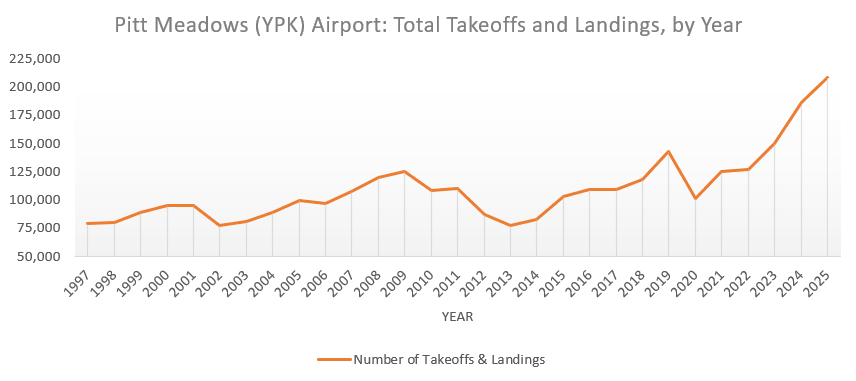
Consider the Pitt Meadows Airport in Metro Vancouver. According to Statistics Canada data, annual aircraft movements surpassed 208,000 in 2025, about twice the level recorded a decade earlier. In practical terms, that growth means an additional aircraft movement every few minutes throughout the day, increasing the volume of lead emissions released into surrounding neighbourhoods.
Pitt Meadows recorded 17,906 takeoffs and landings in June 2026 alone (the most recent data available). That is comparable to the monthly flight activity at Calgary and Montréal's international airports and greater than the totals recorded in Edmonton, Regina, Winnipeg and Halifax. The difference is those airports are dominated by commercial jets that do not operate on leaded fuel, while much of Pitt Meadows' activity involves small piston-engine aircraft that continue to burn leaded avgas.
AI-assisted estimates produced for academic review suggest that total flight activity at Pitt Meadows may now release roughly 366 kilograms of airborne lead annually. That’s equivalent to burning more than 25,000 car tanks of leaded gasoline a year.