Manitoba’s deficit isn’t just a sign of tough economic times
Manitoba’s half-billion-dollar deficit is often framed as a response to economic pressures. But fine print in the province’s 2026 budget tells a more revealing story.

Manitoba’s half-billion-dollar deficit is often framed as a response to economic pressures. But fine print in the province’s 2026 budget tells a different story.
A large share of Manitoba's fiscal shortfall reflects a predictable and long-standing policy failure: not preparing for the rising cost of medical care for aging baby boomers.
If Manitoba’s population still looked like it did in 1976 — when just 10% of residents were over 65, compared to 17% today — the province would be spending about 18% less on medical care. That’s roughly $1.9 billion.
Instead of a deficit of $498 million, Manitoba would be posting a surplus of around $1.4 billion.
For decades, governments have known that the baby boom generation would move into retirement, increasing demand for medical care and driving up public costs. Data from the Canadian Institute for Health Information (CIHI) consistently show that Canadians over age 65 use roughly four times as much medical care as those under 50. As the population ages, costs rise accordingly — and predictably.
In the late 1990s, Ottawa anticipated the fiscal impact of population aging on the Canada Pension Plan and acted, and increased premiums by 68% to keep the program sustainable. Those higher contributions — paid in part by baby boomers during their working years — helped build the reserve required to keep the CPP on track as seniors now draw down their largely pre-funded CPP benefits.
Like other provinces, Manitoba made no comparable adjustment for medical care.
Instead of preparing for the rise in medical costs everyone knew was coming, the province allowed spending pressures to grow without any matching changes to revenue — and then increasingly turned to deficit financing to hide the problem.
The result is plain in Manitoba's 2026 budget. Medical spending is rising by $993 million. More than half of that increase — about $529 million — will go to residents aged 65 and over.
That single increase for older Manitobans is roughly double the entire $262-million increase for K-12 education and early childhood development combined. It is eight times larger than the $66-million increase for postsecondary education. More than nine times larger than the $57-million increase for families. And housing? No increase at all.
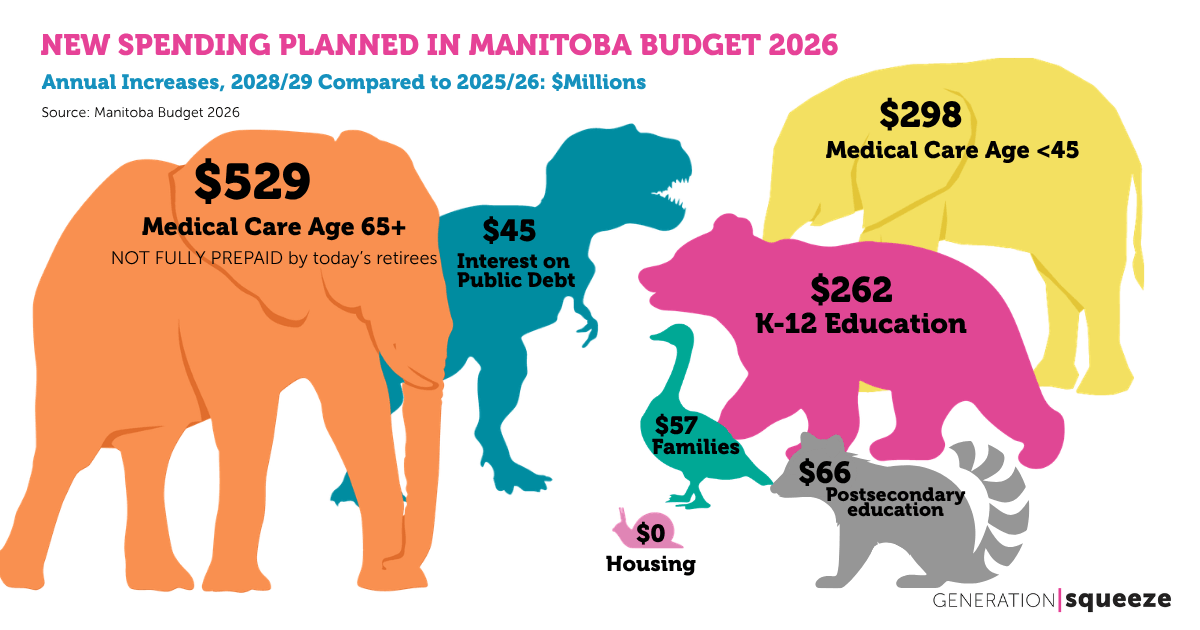
The arithmetic buried in the heart of Budget 2026 is anti-child, anti-parent and anti-young worker.
Without a plan to match increased medical spending for an aging population with sustainable revenue, the outcomes are baked in: deficits grow, and investments in education, training, housing and family supports are crowded out.
There is another consequence. Interest on the public debt will rise again this year, by $45 million – nearly as much as the entire budget increase for families. When governments delay preparing for known demographic pressures, they don’t avoid the bill. They pass more of it forward to younger and future generations.
No one should be surprised that people need more medical care as they age. That’s a success story — one that reflects longer lives and medical progress.
But this success yields a hard question for Manitoba — one all provincial governments have avoided for too long: how should we pay for the medical care we always knew boomers would need, while ensuring the costs are shared fairly across generations in proportion to their use of the system?
Answering this question is essential to sustain high-quality care for older Canadians while also investing adequately in the building blocks of a healthy society for younger generations, like affordable child care, quality education, safe homes, adequate incomes, and a healthy environment.
There is a modest and essential next step for Manitoba. The provincial government should launch a Better Late Than Never Task Force to examine how to modernize revenue systems in light of population aging — bringing together fiscal experts, health leaders and the public.
So long as we continue to blame today’s deficits on short-term economic turbulence, we miss the deeper challenge — the predictable medical costs that come with boomers’ aging — and delay the solutions we have needed all along.