Sep 23, 2026
New Brunswick’s deficit reflects much more than economic turbulence
The primary driver of New Brunswick's 2026 budget deficit isn't global or economic uncertainty. It's the failure to plan enough revenue to pay for population aging.

Andrea Long
/March 27, 2026
New Brunswick’s $1.4-billion deficit is often explained in familiar terms: global economic uncertainty, trade tensions with the United States, and the ripple effects of a fragile post-pandemic economy.
These factors make for convenient explanations. But they obscure a primary reason the province’s finances are under strain: the province's failure to plan enough revenue to pay for population aging.
For decades, governments have known that the baby boom generation would move into retirement, increasing demand for medical care and driving up public costs. This was not a surprise. Data from the Canadian Institute for Health Information (CIHI) consistently show that Canadians over age 65 use roughly four times as much medical care as those under 50. As the population ages, costs rise accordingly — and predictably.
In the late 1990s, Ottawa anticipated the fiscal impact of population aging on the Canada Pension Plan and acted accordingly, increasing premiums by 68%. Those higher contributions — paid in part by baby boomers during their working years — helped build a reserve so the CPP would remain sustainable as they now draw down their largely pre-funded CPP benefits.
New Brunswick (and other provinces) made no comparable adjustment for medical care.
Instead of preparing for the predictable rise in medical costs that accompanies population aging, governments allowed spending pressures to grow without any matching adjustments to revenue — and increasingly turned to deficits to hide the problem.
The result is now visible in provincial budgets across the country, including New Brunswick’s.
If its population still looked like it did when baby boomers were young — with just 9% of residents over age 65 in 1976, compared to 23% today — the province would be spending roughly 31 per cent less on medical care.
That single demographic shift would turn New Brunswick’s projected $1.4-billion deficit into a modest $100 million surplus.
The real issue is not that this fiscal pressure exists. It’s that governments failed to adapt their revenue systems and spending priorities — even though they knew it was coming. The outcome is a growing unpaid bill passed to younger generations, alongside underinvestment in the priorities that matter most for Millennials, Gen Z and their children.
That context is essential for understanding the spending choices in New Brunswick’s latest budget.
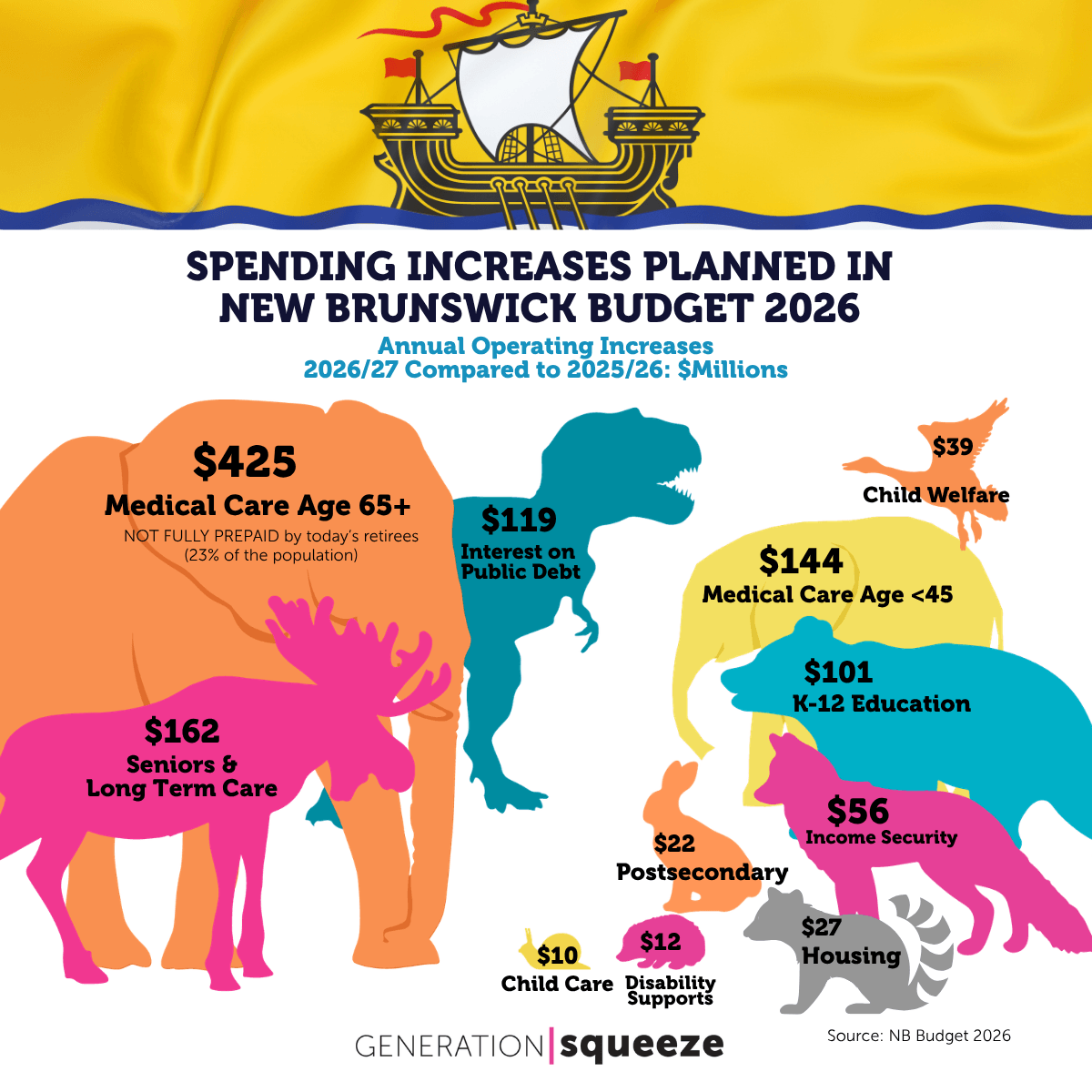
This year, the province is increasing medical spending by $710-million. Applying CIHI data on health spending by age reveals about 60%(or $425 million) of this increase will be allocated to those aged 65 and over.
That’s nearly four times the entire increase for K-12 education and early childhood development combined ($119-million), and almost 20 times the additional funding for postsecondary education ($22-million).
Within the budget for social development, this ageist pattern repeats. Spending on seniors and long-term care is set to rise by $162-million, while child welfare and youth services increase by $39-million — roughly one-quarter as much.
No one should be surprised that people need more medical care as they age. That’s a success story — one that reflects longer lives and medical progress.
But this reality points to a harder question — one we have avoided for too long: how should we pay for the medical care we always knew boomers would need, while ensuring the costs are shared fairly across generations in proportion to their use of the system?
Answering this question is essential to sustain high-quality care for older Canadians and to invest adequately in the building blocks of a healthy society for younger generations: affordable child care, quality education, safe homes, adequate incomes, and a healthy environment.
A reasonable next step is both modest and essential. The provincial government should launch a Better Late Than Never Task Force to examine how to modernize revenue systems in light of population aging, bringing together fiscal experts, health leaders, and the public. Because when we continue to blame today’s deficits on short-term economic turbulence, we miss the deeper challenge — the predictable medical costs that come with boomers’ aging — and delay the solutions we have needed all along.
About Andrea Long
Andrea is the Senior Director for Research and Knowledge Mobilization at Generation Squeeze.
Get Updates
*By clicking "Sign up", you consent to receive periodic updates from Generation Squeeze by email, text and/or phone. You can unsubscribe or text STOP at any time. Message and data rates may apply. Read our privacy policy.