Nova Scotia’s deficit isn’t just about Donald Trump’s Trade War
Nova Scotia’s 2026 budget triggered widespread public backlash. Protests forced the government to reinstate tens of millions in funding for some community programs. The deficit isn’t just about Donald Trump’s Trade War. It reflects a decades-long failure to raise the revenue needed for an aging population.

Nova Scotia’s 2026 budget triggered widespread public backlash. Protests forced the government to reinstate tens of millions in funding for some community programs. That response mattered. But it also missed something bigger.
Nova Scotia’s $1.24-billion deficit is about much more than the contemporary fallout from Donald Trump’s trade war, despite what the Premier suggested when releasing the budget.
At its core, this shortfall reflects a challenge governments have known was coming for decades: the rising cost of medical care as baby boomers age.
In 1976, just 10 per cent of Nova Scotians were 65 or older. By 2025, that share had climbed to 22 per cent.
If the province still had the same age distribution it did 50 years ago, it would be spending 29 per cent less on medical care — about $1.98 billion less – without making any change to the current budget. That alone would erase the deficit and leave a surplus of roughly $730 million.
This is not new information. Population aging has been one of the most predictable forces shaping public finances. Evidence from the Canadian Institute for Health Information (CIHI) shows Canadians over 65 use about four times as much medical care as those under 50. As their share of the population rises, so do public costs for medical care.
Ottawa anticipated demographic pressures in the late 1990s by strengthening the Canada Pension Plan and raising premiums by 68 per cent to pre-fund this key retirement benefit. Provinces did not do the same for medical care. Instead, they allowed costs to rise and increasingly relied on deficits, debt, and trade-offs elsewhere in their budgets.
That pattern is now unmistakable in Nova Scotia’s 2026 budget.
Medical spending is set to rise by $738 million this year. Nearly two-thirds of that increase — $465 million — is tied to care for those aged 65 and over. Seniors and long-term care receive another $111 million.
Taken together, new spending tied to older populations approaches $600 million. That is the dominant fiscal story in this budget.
Everything else is much smaller. The combined increase for K-12 education and child care is $116 million — roughly one-fifth as much. Housing receives $75 million — barely one-eighth.
And while spending tied to older Nova Scotians grows by over half a billion dollars, postsecondary education is cut by nearly $190 million.
Within the budget for the department of Social Development, there are increases for disability supports ($41 million) and income assistance ($65 million). But funding for Child and Family Wellbeing falls by $4 million.
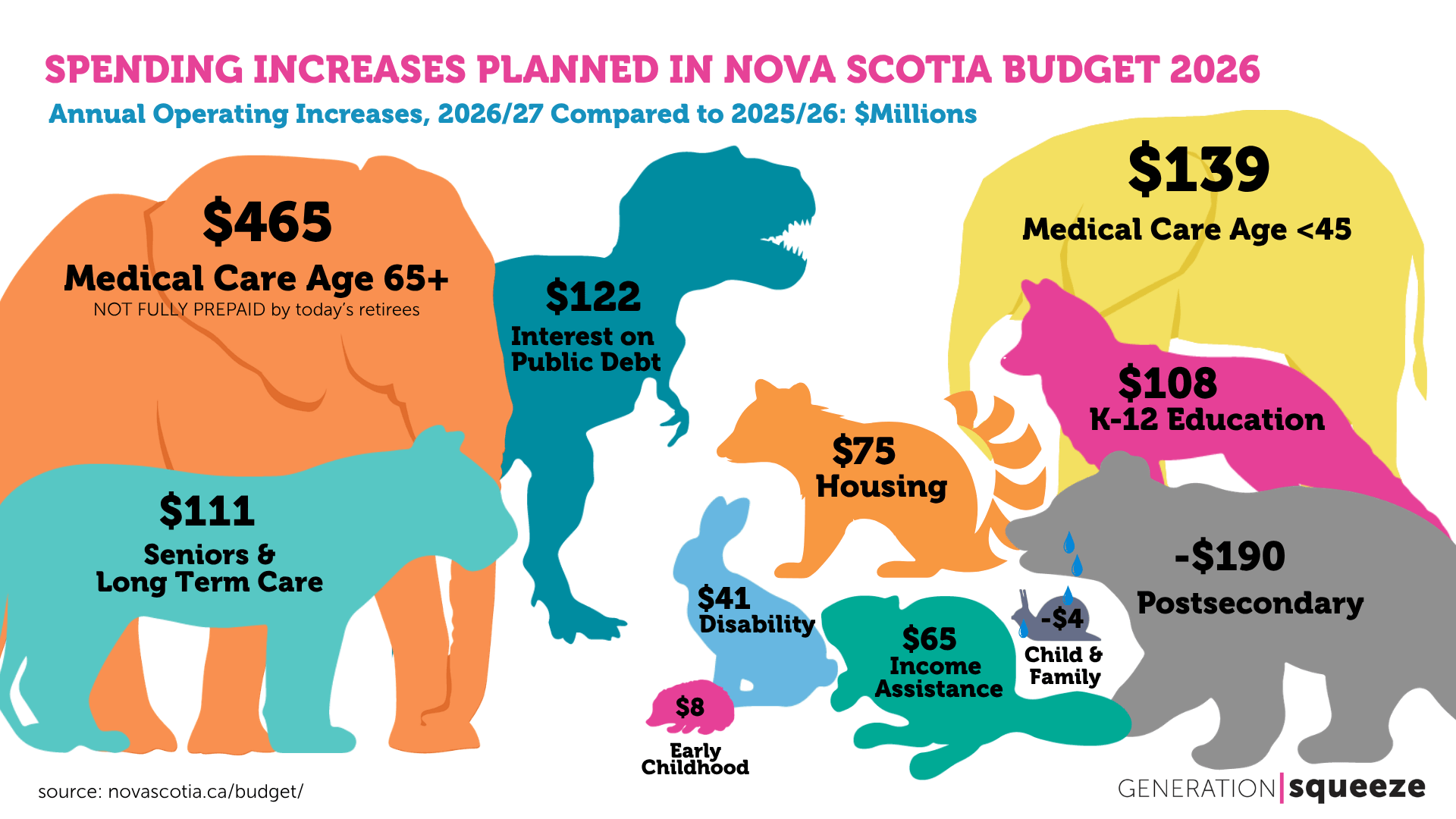
Failure to raise the revenue needed to pay for predictable demographic change isn’t just crowding out investment in younger Canadians. The pressure compounds over time. In the 2026 budget, this shows up in debt servicing costs that rise by nearly $122 million — more than the combined increase for child care, K-12 education and postsecondary.
To be clear, an aging population is something to celebrate. Longer lives reflect real progress. The problem is not that older Nova Scotians need more care. It is that governments failed to prepare so the costs would be shared fairly across generations, as Ottawa did when it strengthened the CPP.
That failure now shapes the choices made for everyone else.
When hundreds of millions in new spending are absorbed by medical care for an aging population, less remains for the foundations of wellbeing: education, housing, child development, and opportunity for younger workers.
That is why this budget fits a pattern now visible across Canada. It is anti-child, anti-parent and anti-young worker.
The public outcry that followed this budget focused on specific cuts — and succeeded in reversing some of them. But it has not confronted the deeper problem: a widening gap between what governments spend on aging populations and what they invest in younger generations. That gap reflects systemic ageism against younger residents, built into the foundation of the province’s fiscal plan.
Until that changes, Nova Scotia — like every province — faces the same unresolved question: how do we pay for the medical care we always knew baby boomers would need, while protecting adequate investment in younger people and the province’s credit rating?
That question cannot be answered by pointing to trade wars or short-term economic pressures.
A practical next step would be to establish a Better Late Than Never Task Force to examine how Nova Scotia can modernize its revenue system in response to population aging. Bringing together fiscal experts, health leaders and the public, such a process could finally confront the issue that has been deferred for too long: how do we pay — better late than never — for the costs of caring for boomers that we always knew were coming.