PEI can lead premiers to fix the structural problem behind every provincial deficit
PEI Premier Rob Lantz is uniquely positioned to lead Canada’s premiers in fixing the structural problem at the heart of every provincial budget.

PEI Premier Rob Lantz is uniquely positioned to lead Canada’s premiers in fixing the structural problem at the heart of every provincial budget.
After tabling a record $410 million deficit, Lantz spoke candidly on Power & Politics on April 21, 2026, acknowledging that his province—and all provinces—face a shared “structural” fiscal challenge. As Chair of the Council of the Federation, he now has a rare opportunity: to turn that admission into coordinated national action.
The primary structural problem is clear. Provinces failed to plan for the predictable costs of population aging.
If Prince Edward Island had the same age distribution today as when baby boomers were young, the province would be spending 23 per cent less on medical care—about $325 million less each year, without changing anything else in its budget. That savings alone would eliminate roughly 80 per cent of the PEI deficit in Budget 2026.
The reason is straightforward. In 1976, just 11 per cent of PEI’s population was aged 65 and over. Today, that share has nearly doubled to 21 per cent.
This shift—and the pressure it would place on the medical system—was entirely foreseeable. Evidence from the Canadian Institute for Health Information shows that Canadians over 65 use about four times more medical care than those under 50. As their share of the population rises, so too do public costs.
Ottawa prepared for this reality when it strengthened the Canada Pension Plan in the late 1990s, raising premiums by 68 per cent to pre-fund retirement benefits. Provinces did not do the same for medical care. Instead, they allowed costs to grow and relied increasingly on deficits, rising debt, and difficult trade-offs elsewhere in their budgets.
Those trade-offs are now unmistakable in PEI’s latest fiscal plan.
Medical care spending is rising by $175 million in a single year. Of that increase, $105 million —60 per cent —will be used by the 21 per cent of Islanders aged 65 and over.
By comparison, investments in younger generations are far more limited.
- Spending on K–12 education and early childhood development rises by just under $40 million combined.
- Postsecondary funding increases by less than $5 million.
- Social programs grow by $15 million, along with $5 million more for child and family services.
- Housing spending is cut slightly.
Meanwhile, the cost of servicing the public debt climbs by $269 million.
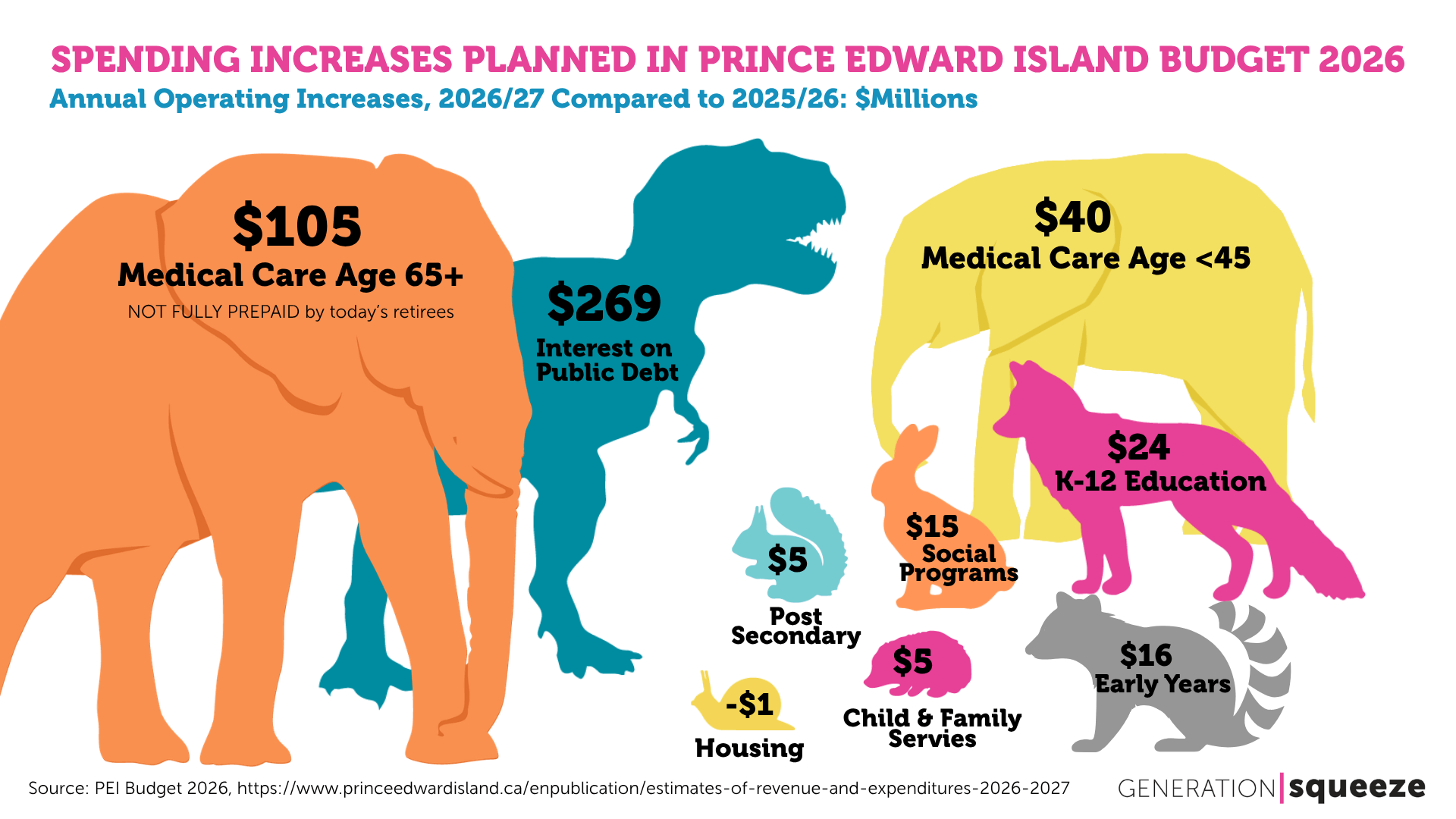
This is what happens when governments fail to prepare for predictable demographic change. Rising medical costs crowd out investments in the foundations of wellbeing—education, housing, and supports for families. When revenues fall short, deficits grow, and the bill is passed to younger and future generations.
These budgets are not neutral. They are anti-child, anti-parent and anti-young-worker.
To be clear, longer lives are something to celebrate. The problem is not that older Islanders need more care. It is that governments failed decades ago to prepare so those costs could be shared fairly across generations. As a result, Millennials already pay 20 to 40 per cent more in income taxes to support retiree health costs than boomers paid for seniors when they were the same age.
Premier Lantz has already taken an important first step by naming the structural challenge. The next step is to lead.
As Chair of the Council of the Federation, he can bring premiers together to design a revenue plan that matches the predictable costs of aging. A practical place to start would be a Better Late Than Never Task Force — bringing together fiscal experts, health leaders, and the public to answer a question provinces have avoided for too long: how do we pay for the medical care we always knew baby boomers would need, while protecting adequate investment in younger people and the province’s credit rating?
Without that leadership, provinces will remain trapped — treating symptoms while the underlying fiscal disease worsens, and continuing to pass the costs of inaction onto younger Canadians.