Pollution Pricing Progress Still Leaves the Biggest Bills to Our Kids
Both the Ottawa’s budget and the newly signed Canada–Alberta MOU reaffirm the commitment to strengthen industrial pollution pricing – meaningful progress that should be acknowledged. Yet the deal between Ottawa and Alberta creates environmental risks (weaker national standards), political risks (emboldening provinces to push for further carve-outs), and economic risks (reduced investor certainty). Each of these makes it harder to meet Canada’s climate goals – and easier for today’s pollution to become tomorrow’s multibillion-dollar bill for younger people.

Recent climate moves in Ottawa and Alberta reflect governments trying to balance affordability pressures, industry competitiveness, trade disruptions and the urgency to reduce pollution. Within that balancing act, Canada has taken a small but meaningful step toward strengthening industrial pollution pricing. Because carbon pricing does the heavy lifting in our emissions-reduction strategy, even incremental progress matters.
Still, these steps sit within a wider policy landscape where some choices negotiated in the MOU between Ottawa and Alberta will weaken Canada’s climate competitiveness. This betrays our children and future generations, by shifting the economic and environmental costs of delay onto them.
The industrial pollution price is here to stay
A commitment to strength industrial pollution pricing is real progress that’s worth naming. Both the November budget and the newly signed Canada–Alberta MOU reaffirm the commitment to strengthen the industrial price on pollution – even in the face of relentless misinformation from Mr. Poilievre about its impact on living costs.
Alberta’s agreement to move from an industrial carbon price frozen at $95 per tonne to a minimum of $130 per tonne is meaningful – provided the province delivers. This increase would ensure Alberta more fairly shares the costs of pollution with other jurisdictions across Canada, while also creating stronger incentives for businesses to cut emissions. As Rick Smith of the Canadian Climate Institute puts it, modernizing Alberta’s industrial pollution pricing system – which alone covers roughly a quarter of Canada’s total emissions – is “one of the most important and cost-effective steps the province can take to reduce emissions.”
But this is step forward comes in a landscape where the ground is shifting backward.
'Climate competitiveness' shouldn't mean betraying our kids
The federal budget’s “climate competitiveness strategy” signaled an important intent to align climate action with economic resilience. Yet the plan was short on details about how to accelerate emissions reductions, and also scaled back commitments in several areas. By doing so, it missed the opportunity to confront a central fact: delaying action now simply increases the environmental and economic burdens that will fall on our kids, grandchildren and future generations. A credible competitiveness strategy cannot rest on passing those risks forward.
The Canada–Alberta MOU compounds these concerns. While it strengthens the national benchmark for industrial pricing, it simultaneously weakens the broader principle that Ottawa can set and enforce consistent national standards across provinces. By offering Alberta carve-outs on measures like clean electricity regulations, the agreement invites other provinces to demand similar treatment – risking a patchwork of exceptions rather than a coherent national framework. Investors need clarity and stability, not a system where climate policy becomes a province-by-province negotiation.
It’s no surprise that the Canadian Climate Institute stated that the MOU is “inconsistent with the federal Climate Competitiveness Strategy” released only weeks earlier. The deal between Ottawa and Alberta creates environmental risks (weaker national standards), political risks (emboldening provinces to push for further carve-outs), and economic risks (reduced investor certainty). Each of these makes it harder to meet Canada’s climate goals – and easier for today’s pollution to become tomorrow’s multi-billion-dollar bill for younger people.
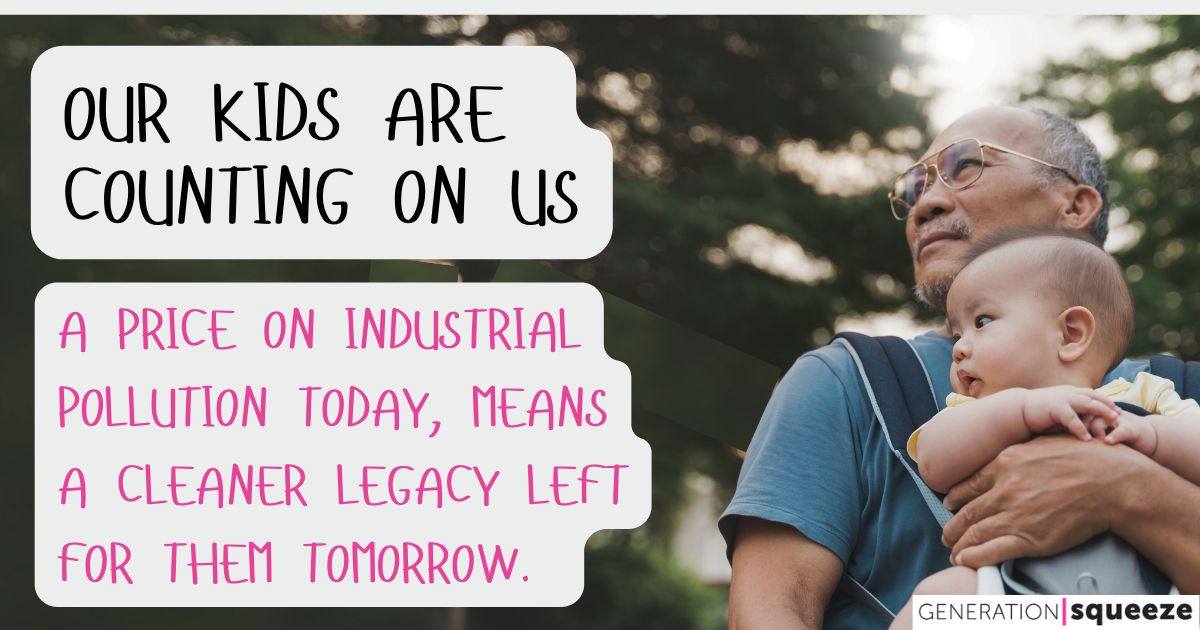
Our network knows what’s at stake: the legacy we leave to those who follow us. We cannot betray our kids and future generations by asking them to pay dearly for the pollution we allowed industry to dump for free. A well-designed industrial carbon price – as outlined in our Good Ancestor Toolkit – ensures the biggest polluters pay to reduce emissions, keeps costs low for business, and has virtually no impact on household budgets. It is one of the most effective tools we have to prevent industries from dumping pollution at no cost, and leaving the consequences to our kids.
Neither the Budget nor the MOU does enough to guarantee this outcome. Both documents point to the need for progress, while simultaneously making concessions that risk undercutting the very standards Canada needs to urgently uphold.
In sum, the MOU strengthens industrial pricing, but only modestly — it’s a foundation, not a finish line. That’s why this is a crucial moment for advocacy. Canada needs the federal government to convert this early progress into a stronger, consistent national system with a clear long-term trajectory that matches the climate risks our children will inherit.
If you haven’t yet added your voice, now is the time!
The costs of weak policy and further delay will be paid by our kids and grandkids. The benefits of stronger standards are still ours to choose. Politics respond to those who organize and show up – so please join us in pressing Ottawa, and provincial and territorial governments, to leave a cleaner legacy.