Saskatchewan’s deficit isn’t just about economic headwinds
Saskatchewan’s $819-million stems from a long-anticipated challenge that governments have yet to fully address: the growing cost of medical care as baby boomers age.
Saskatchewan’s $819-million deficit is often explained as the product of uncertain economic conditions. But a closer reading of the 2026 budget reveals a more fundamental driver.
The shortfall stems from a long-anticipated challenge that governments have yet to fully address: the growing cost of medical care as baby boomers age.
In 1976, just 11 per cent of Saskatchewan residents were 65 or older. Today, that share has climbed to 18 per cent. If the province still had the younger age profile it did nearly 50 years ago, it would be spending about 15 per cent less on medical care — roughly $1.3 billion less.
That difference alone would more than eliminate the current deficit, leaving a projected surplus of about $444 million.
None of this should come as a surprise. Governments have long known that the baby boom generation would enter retirement, bringing higher demand for medical services. Evidence from the Canadian Institute for Health Information (CIHI) shows that Canadians over age 65 use about four times as much medical care as those under 50. As the population ages, public costs rise in step.
Ottawa responded to this reality in the late 1990s when it strengthened the Canada Pension Plan, raising premiums by 68 per cent to ensure the system remained sustainable as boomers retired. Those higher contributions helped pre-fund the benefits retirees now receive.
Provinces, however, did not take similar steps for medical care. Rather than adjusting revenues to keep pace with demographic change, governments allowed costs to climb and increasingly relied on deficits to bridge the gap.
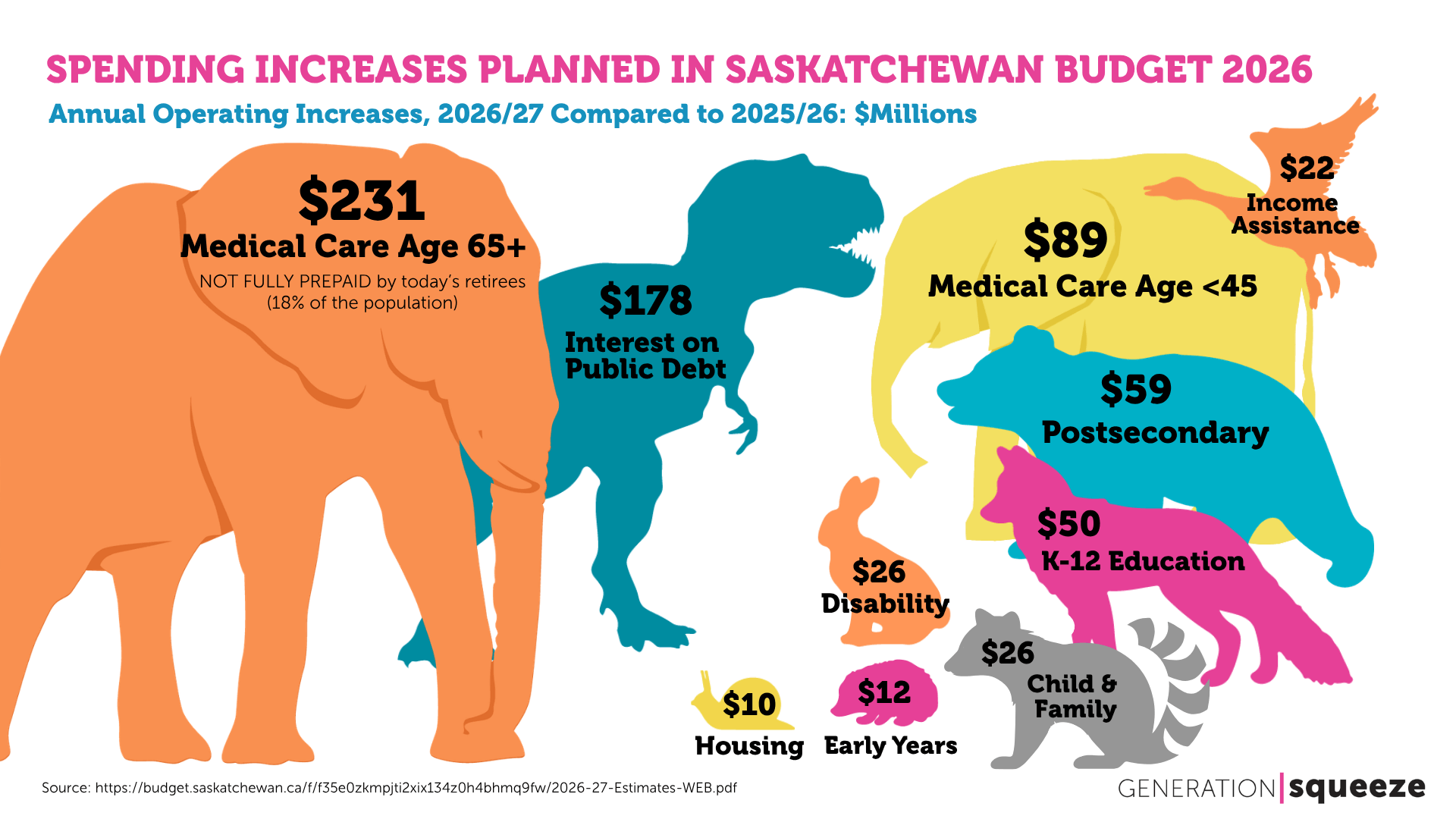
That approach is now clearly visible in Saskatchewan’s latest budget. Medical spending is set to increase by $393 million this year. Nearly 60 per cent of that growth — about $231 million — is tied to care for residents aged 65 and over. That increase for older residents alone is more than four times the additional $50 million for K-12 education. It is close to 19 times the $12-million increase for early years programs.
Even taken together, the increases for K-12 and early years reach just over $62 million — only a fraction of the added spending directed to seniors.
Postsecondary education sees a $59-million increase. Disability programs and services rise by $26 million, as do child and family services. Income assistance grows by $22 million. Housing receives just $10 million.
These are meaningful investments. But they are being overshadowed by the pace of growth in medical spending tied to an aging population.
This is the fiscal pattern embedded in Budget 2026 — one that places mounting pressure on supports for children, families and younger workers. It is anti-child, anti-parent and anti-young worker.
Without a strategy to align revenues with the predictable rise in medical costs, the consequences are inevitable: persistent deficits and tighter constraints on spending for education, housing, and social supports.
There is also a compounding effect. Debt servicing is projected to increase by $178 million. When governments postpone dealing with known demographic pressures, the costs don’t disappear. They accumulate — and are increasingly shifted onto younger and future generations.
An aging population needing more care is, in many ways, a success story. It reflects longer lives and advances in medicine.
But it also raises a difficult question — one Saskatchewan shares with every province: how do we pay for the medical care we always knew boomers would need, while ensuring the costs are shared fairly across generations in proportion to their use of the system?
Answering that question is essential not only to maintain high-quality medical care for older Canadians, but also to ensure adequate investment in the foundations of well-being for younger generations — including education, child care, housing, income security and environmental sustainability.
A practical next step would be to establish a Better Late Than Never Task Force to examine how Saskatchewan can modernize its revenue system in response to population aging. Bringing together fiscal experts, health leaders and the public, such a process could finally confront a question that has been deferred for too long: how do we pay — better late than never — for the care we always knew was coming?
Until that happens, deficits like today’s will continue to be treated as short-term problems, rather than what they really are — the predictable result of failing to prepare for the costs of an aging society.