Write To The Prime Minister
Urge the Prime Minister and Minister of Finance to Fix OAS today.
Amid a cost-of-living crisis, Canada is on track to spend $17.5 billion annually on retirees with six-figure incomes even after existing clawbacks are applied.
Retired couples with up to $186,000 in household income can receive the full $18,000 Old Age Security subsidy. Yet too many seniors still live in poverty, and young and working Canadians struggle to afford the basics.
That $17.5 billion spend on retirees with $100,000+ incomes is:
The fix is simple: begin reducing OAS subsidies for retired couples once household income exceeds $100,000.
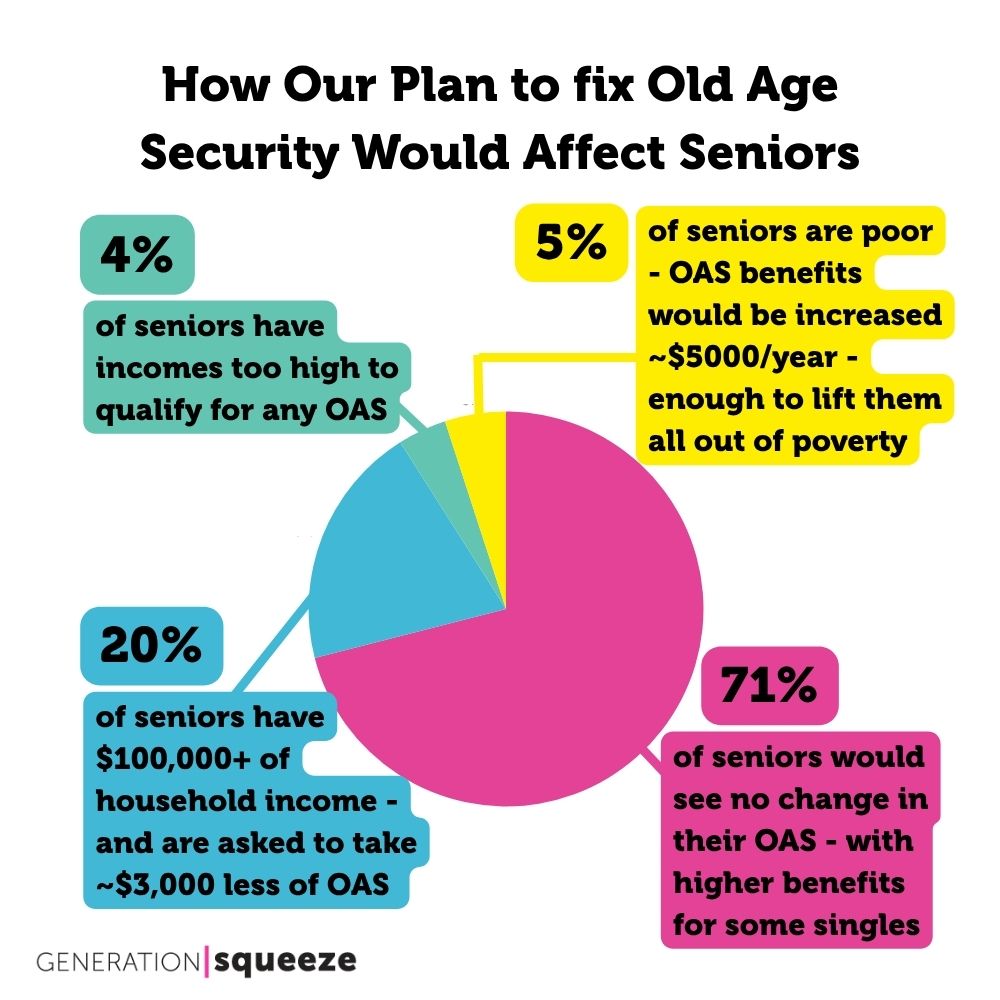
This responsible reform protects or improves benefits for 80% of recipients, while asking the top 20% to accept about $3,000 less per year. It saves $7 billion today, and $9 billion by 2030 — savings drawn entirely from households with 1/3 more income than the family median.
With these savings, Canada could:
Urge the Prime Minister and Minister of Finance to Fix OAS today.
You can grow the impact of our movement by sharing a sentence or two about why OAS reform matters to you, along with a photo.
Urge your MP to support fixing OAS today.
Modernizing Old Age Security frees billions to help people afford the basics. Our plan will eliminate seniors' poverty and grow investments in housing and income security young and working Canadians....
Despite costing more than any other federal program, OAS leaves 400,000 seniors in poverty. Too much of the OAS budget goes to retirees with household incomes above $100,000 — and not enough to those facing financial risks. With uncertainty and living costs on the rise, we can no longer afford this inefficient spending.

By trimming OAS subsidies only for retirees with six-figure incomes, we could unlock enough savings to lift all seniors out of poverty and help young and working-age people afford the basics. That’s an intergenerational win-win.

Canada’s population is aging and living longer — demographic realities our revenue systems weren’t designed to cope with. The result of governments’ failure to prepare for these long-expected pressures is a growing gap between the contributions seniors made in their working years, and the cost of the services they now expect to use in retirement.
The Basic Income Canada Network (BICN) formally endorses Gen Squeeze’s plan to Fix OAS as a strategy to increase Canada’s national ambition to reduce poverty even in this difficult era of austerity.
BICN advances human-rights based public policy that ensures everyone has enough income to meet basic needs, live with dignity, and participate in society and the economy.
Therefore be it resolved that the Health Officers Council be of the position that: The federal government should restructure OAS to ensure that it is optimized to improve population health outcomes.
and be it further resolved that: The federal government considers phasing out OAS benefits at a threshold similar to other federal income tested benefits to better align funding distribution with population health benefit.
and be it further resolved that: A portion of the savings from this restructuring be used to significantly reduce seniors’ poverty by increasing incomes for seniors below the official poverty measure;
and be it further resolved that: The remaining savings be invested to improve the social determinants of health for younger generations, including through enhanced supports for housing, childcare, postsecondary education, and poverty reduction.
The Health Officers Council of BC represents provincial public health physicians.
Read the full text of the July 2026 Health Officers Council Resolution here.
The quiet bargain our politics increasingly offers my generation is this: lower your expectations so nobody else has to sacrifice. Most Canadians, including many seniors, would reject that bargain if we discussed it honestly.
There is evidence they already do. A large majority of retirees support reducing OAS for higher-income households if the savings help eliminate seniors’ poverty and improve affordability for younger Canadians.
If we're serious about building Canada Strong, we need to fix OAS
Ipolitics, September 21, 2026
Our social spending heavily favours older people at the expense of younger generations… [OAS and GIS] are an important part of our social welfare but they were designed for a different time.
OAS, which is funded entirely from general taxpayer revenue, is projected to increase from $55 billion in 2024 to over $90 billion by 2030 – a 64% increase in just six years. This rapid growth is happening while the very generations expected to fund these payments are facing unprecedented economic challenges.
Brighter Futures: Giving Every Child a Head-Start Fund. March 10, 2025
While Old Age Security (OAS) has become more generous over the last 50 years, government transfers to younger Canadians remain unchanged.
Canada is overdue for a broader debate on intergenerational fairness and how our taxes and benefits support — and exclude —different age groups. We continue to live with programs designed by baby boomers to provide security to seniors — even if they are well off. Yet young adults in our country face challenges entering the labour market, securing stable employment and saving to build some measure of economic security in the face of rising costs in almost every sector.
A youth employment supplement could rebalance Canada’s generational divide
Kiran Gill and Matthew Mendelsohn, February 12, 2026
Youth have not been a sufficiently high priority for federal spending. For example, while Old Age Security (OAS) is projected to see a $28 billion annual spending increase by 2029, youth unemployment funding is expected to increase by less than $1 billion. Fourteen billion dollars is currently spent on OAS subsidies to high-income retiree households. Old Age Security could be reformed by slowing the growth of payments to households with six-figure incomes. This would free up $7–$8 billion annually. A portion of these funds could be redirected to investments in post-secondary education, housing, or other youth unemployment-related policies.
Youth have not been a sufficiently high priority for federal spending. For example, while Old Age Security (OAS) is projected to see a $28 billion annual spending increase by 2029, youth unemployment funding is expected to increase by less than $1 billion. Fourteen billion dollars is currently spent on OAS subsidies to high-income retiree households. Old Age Security could be reformed by slowing the growth of payments to households with six-figure incomes. This would free up $7–$8 billion annually. A portion of these funds could be redirected to investments in post-secondary education, housing, or other youth unemployment-related policies.
We Can't Ignore This: Confronting the Crisis of Youth Unemployment. Report of Roundtable on the Crisis of Youth Unemployment, 2026
Co-Sponsored by Senators Andrew Cardozo, Amina Gerba, Katherine Hay, Danièle Henkel, Marilou McPhedran, Farah Mohamed, Kristopher Wells
Among income security programs in Canada, OAS is unusual in the generosity it shows to wealthier families. The income at which benefits are reduced, coupled with a low reduction rate, means a couple with a combined income exceeding $300,000 could conceivably still receive a small OAS benefit. These funds would be better spent if they were redirected to seniors in greatest need.
Among income security programs in Canada, OAS is unusual in the generosity it shows to wealthier families. The income at which benefits are reduced, coupled with a low reduction rate, means a couple with a combined income exceeding $300,000 could conceivably still receive a small OAS benefit. These funds would be better spent if they were redirected to seniors in greatest need.
There’s a lot of work to do, but some top-line items, OAS is a big one. Essentially, we need to make sure that seniors, of course, stay out of poverty, but we should not be funding their luxury retirements because that’s not the point of these policies, and it’s really hurting younger generations and putting them in a position where they’re going to be paying off this debt for years and years to come. OAS should be cut off at the average income of Canadians of all ages.
There’s a lot of work to do, but some top-line items, OAS is a big one. Essentially, we need to make sure that seniors, of course, stay out of poverty, but we should not be funding their luxury retirements because that’s not the point of these policies, and it’s really hurting younger generations and putting them in a position where they’re going to be paying off this debt for years and years to come. OAS should be cut off at the average income of Canadians of all ages.
Are Boomers Bankrupting the Future?. Mike Moffatt and Sabrina Maddeaux, The Missing Middle Podcast. November 26, 2026
Old Aged Security… has become a morally unjustifiable upward transfer of wealth from struggling young people to high income seniors. I hope that the @CPC+_HQ will have the courage and integrity to demand similar common sense reforms!
Old Aged Security… has become a morally unjustifiable upward transfer of wealth from struggling young people to high income seniors. I hope that the @CPC+_HQ will have the courage and integrity to demand similar common sense reforms!
Posted on X. September 22, 2026
Canada has been forced to revisit long-standing growth models amidst geopolitical and economic turmoil. But few files show the strain on legacy policy architecture more clearly than those meant to support Canadians as they age.”
OAS is a practical place to begin [reforms] because it was built for a different era and no longer reflects today’s demographic and socioeconomic realities.
Its broad-based structure is increasingly hard to defend as trade-offs across competing priorities— and generations—mount.
Putting redesign on the table should not be about revisiting old ideological fights. It should be framed as an opportunity to give Canadians across the lifecycle a more credible and practical financial foothold in an era of longevity—one they may judge less at the ballot box than in their own pocketbooks.
[Prime Minister] Carney and the boomers can save Canada” by implementing Gen Squeeze’s plan to Fix OAS.
[Prime Minister] Carney and the boomers can save Canada” by implementing Gen Squeeze’s plan to Fix OAS.
How Mark Carney and the baby boomers can save Canada. National Observer, August 18, 2025
...no responsible fiscal plan is possible without reining in the costs of Old Age Security payments. Right now, OAS payments are sent to seniors whose retirement years are amply secure. A couple with an $181,000 household income would together receive annual payments of nearly $18,000, without benefits being clawed back. Taxing poorer, younger Canadians to cut cheques for wealthy retirees is nonsensical at the best of times, and incomprehensible when debt costs are surging.
...no responsible fiscal plan is possible without reining in the costs of Old Age Security payments. Right now, OAS payments are sent to seniors whose retirement years are amply secure. A couple with an $181,000 household income would together receive annual payments of nearly $18,000, without benefits being clawed back. Taxing poorer, younger Canadians to cut cheques for wealthy retirees is nonsensical at the best of times, and incomprehensible when debt costs are surging.
The next steps the Liberals must take to restore Canada’s fiscal stability. The Globe and Mail, November 9, 2025
Old Age Security needs to be reformed — not expanded... The problem is the program’s clawback thresholds are too high... Only seniors earning above $148,000* are entirely ineligible. And because the program does not look at family income, a senior couple who together earn as much as $296,000* could still be eligible for some Old Age Security.
Another worthy reform would be for the government to look at the family income of senior couples when determining eligibility for Old Age Security — a concept the government already applies to various other programs. Family income is considered for the Canada Child Benefit, the Canada Dental Care Plan, the GST/HST credit and, indeed, OAS’s sister program, the Guaranteed Income Supplement. The income threshold for many of these programs is far less generous than it is for Old Age Security.
In short, there is much the federal parties could do to make Old Age Security more effective, affordable and fair. Simply increasing payouts to those who are already eligible misses the mark.
* 2026 figures are $186,000 of household income for full eligibility, with partial eligibility up to $304,000 for those ag 65-74 and $314,000 for those age 75+.
Editorial: Old Age Security must be reformed — not expanded. Canadian Affairs, October 4, 2024
While some programs such as the Guaranteed Income Supplement (GIS) provide additional income support to low-income seniors, OAS provides support to many upper middle-income seniors… Increasing OAS payments will cost billions each year while supplementing the income of many seniors who aren’t in need.
While some programs such as the Guaranteed Income Supplement (GIS) provide additional income support to low-income seniors, OAS provides support to many upper middle-income seniors… Increasing OAS payments will cost billions each year while supplementing the income of many seniors who aren’t in need.
Canadians should understand costs of expanding Old Age Security. Fraser Institute, October 13, 2024
We can no longer treat staggeringly expensive programs like OAS, along with the broader network of senior-focused supports, as untouchable. If these programs were recalibrated, lower-income seniors could remain protected while affluent ones received less. Those reductions would add billions that could help younger Canadians make ends meet, reduce public debt, and fund transit, clean energy, education and health care.
We can no longer treat staggeringly expensive programs like OAS, along with the broader network of senior-focused supports, as untouchable. If these programs were recalibrated, lower-income seniors could remain protected while affluent ones received less. Those reductions would add billions that could help younger Canadians make ends meet, reduce public debt, and fund transit, clean energy, education and health care.
The Great Generational Rip Off, September 22 2026
Ottawa should not increase OAS benefits because...
"We need to avoid worsening intergenerational frictions in Canada and to conserve needed fiscal room for spending on other priority areas... the public pillars of our current retirement income system provide robust income supports.”
Ottawa should not increase OAS benefits because...
"We need to avoid worsening intergenerational frictions in Canada and to conserve needed fiscal room for spending on other priority areas... the public pillars of our current retirement income system provide robust income supports.”
Ottawa must not bow to the Bloc and boost Old Age Security for younger seniors. Published in the Globe and Mail, September 26, 2024
A married couple receiving OAS with no clawback with a household income of almost $200,000… Seniors are very well looked after in Canada.
For younger Canadians: “even if they’re more trained and more educated, they’re into jobs that are a long long way from a combined household incomes of $200,000.”
Generational inequality and the West Coast pipeline. The Hub, October 10, 2025
Tightening OAS eligibility is of course a terrible political move for a Prime Minister who owes his win to Boomers who trusted him to preserve their status quo, but it is a necessary move for a Prime Minister – or anyone, frankly – who can recognize that it is patently insane to keep handing out billions of dollars to wealthy seniors in this economic environment. If Mr. Carney is indeed “completely focused on getting our economy back on track,” he will ignore the political noise, and do it.
Tightening OAS eligibility is of course a terrible political move for a Prime Minister who owes his win to Boomers who trusted him to preserve their status quo, but it is a necessary move for a Prime Minister – or anyone, frankly – who can recognize that it is patently insane to keep handing out billions of dollars to wealthy seniors in this economic environment. If Mr. Carney is indeed “completely focused on getting our economy back on track,” he will ignore the political noise, and do it.
Canada needs to rein in spending. How about we stop handing out billions to wealthy seniors?. The Globe and Mail, October 23, 2025
Ottawa’s increasing OAS spending dedicates scarce public resources on the by-and-large much more well-off older generations. Canadians aged 65 and older have a median net worth now above $1 million, compared to Canadians under 35 having a median net worth of only $48,000, according to research conducted by CEO of Ipsos Public Affairs Darrell Bricker. Missing Middle Initiative founding director and Hub contributor Mike Moffatt calculated that, on average, the income of men older than 65 now surpasses the average income of men aged 25 to 34, with seniors making more than $60,000.
Ottawa’s increasing OAS spending dedicates scarce public resources on the by-and-large much more well-off older generations. Canadians aged 65 and older have a median net worth now above $1 million, compared to Canadians under 35 having a median net worth of only $48,000, according to research conducted by CEO of Ipsos Public Affairs Darrell Bricker. Missing Middle Initiative founding director and Hub contributor Mike Moffatt calculated that, on average, the income of men older than 65 now surpasses the average income of men aged 25 to 34, with seniors making more than $60,000.
Federal spending on Old Age Security will outpace child care, housing, and postsecondary education combined. The Hub, November 21, 2025
OAS benefit increases are “really bad policy… Meeting people’s needs, especially the elderly, that’s very important. But understand this is not targeted to those who need it. This is universal. It’s a bad idea. It’s too expensive.”
OAS benefit increases are “really bad policy… Meeting people’s needs, especially the elderly, that’s very important. But understand this is not targeted to those who need it. This is universal. It’s a bad idea. It’s too expensive.”
Intergenerational equity is strained across the advanced world. Social welfare systems designed and enjoyed by previous generations will prove, absent reform, unaffordable for future ones.
Intergenerational equity is strained across the advanced world. Social welfare systems designed and enjoyed by previous generations will prove, absent reform, unaffordable for future ones.
Values: Building a Better World for All, p. 11
When the Conservatives formed government in 2012, Pierre Poilievre supported OAS reform. He argued that by the early 2030s:
"...the number of people on OAS will double, the cost will triple, and the number of taxpayers supporting each retiree will fall by half… We need to think of OAS as a glass of water. Retirees can only drink out of the cup in benefits what workers pour into it in taxes. If Canadians are drinking out of the cup faster than what is poured in, then someone goes thirsty."
House of Commons Hansard, May 7, 2012
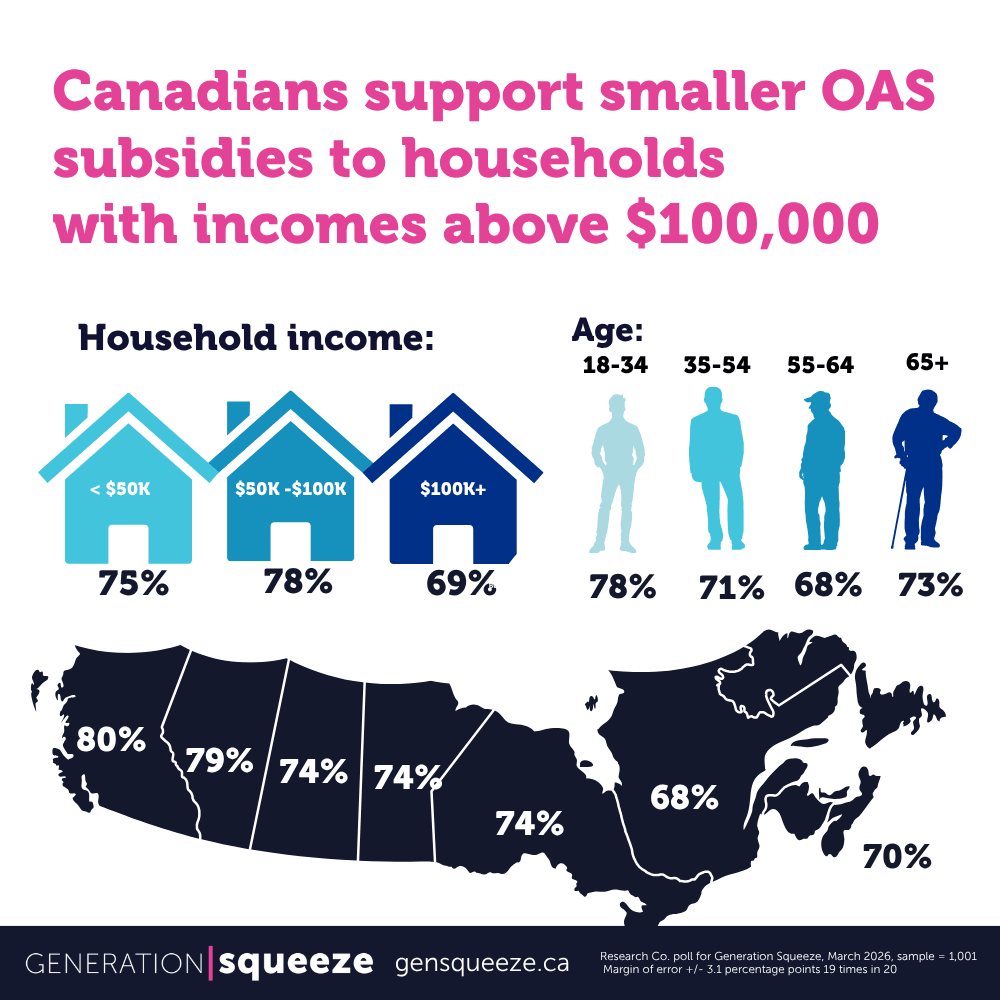
Canadians have spoken — clearly and consistently. Just as they did in 2024, independent polling conducted by Research Co. shows that three-quarters support responsible OAS reforms that trim subsidies for retired couples with six-figure incomes. Just 10% think the status quo is acceptable.
OR
It doesn't make sense to send $18,000 in OAS subsidies to retired couples with $186,000 in household income when others struggle to afford the basics. Our plan will redirect billions to eliminate seniors' poverty and improve affordability for young and working-age people.
Old Age Security (OAS) is a subsidy the Government of Canada pays to seniors who are age 65 and older.
As of April 2025, individual seniors with up to $93,000 of annual income receive $9,000 annually in OAS cash benefits.
Senior couples with up to $182,000 in annual income can receive $18,000 annually in OAS benefits. Because seniors can rely on pension income splitting (which isn't available to other household types), they are able to maximize their OAS subsidies.
All seniors are eligible for OAS if they are Canadian citizens or legal residents, and if they have resided in Canada for at least 10 years since the age of 18. Employment history does not determine eligibility for OAS. Seniors can still receive the subsidy if they have never worked, or if they are still working.
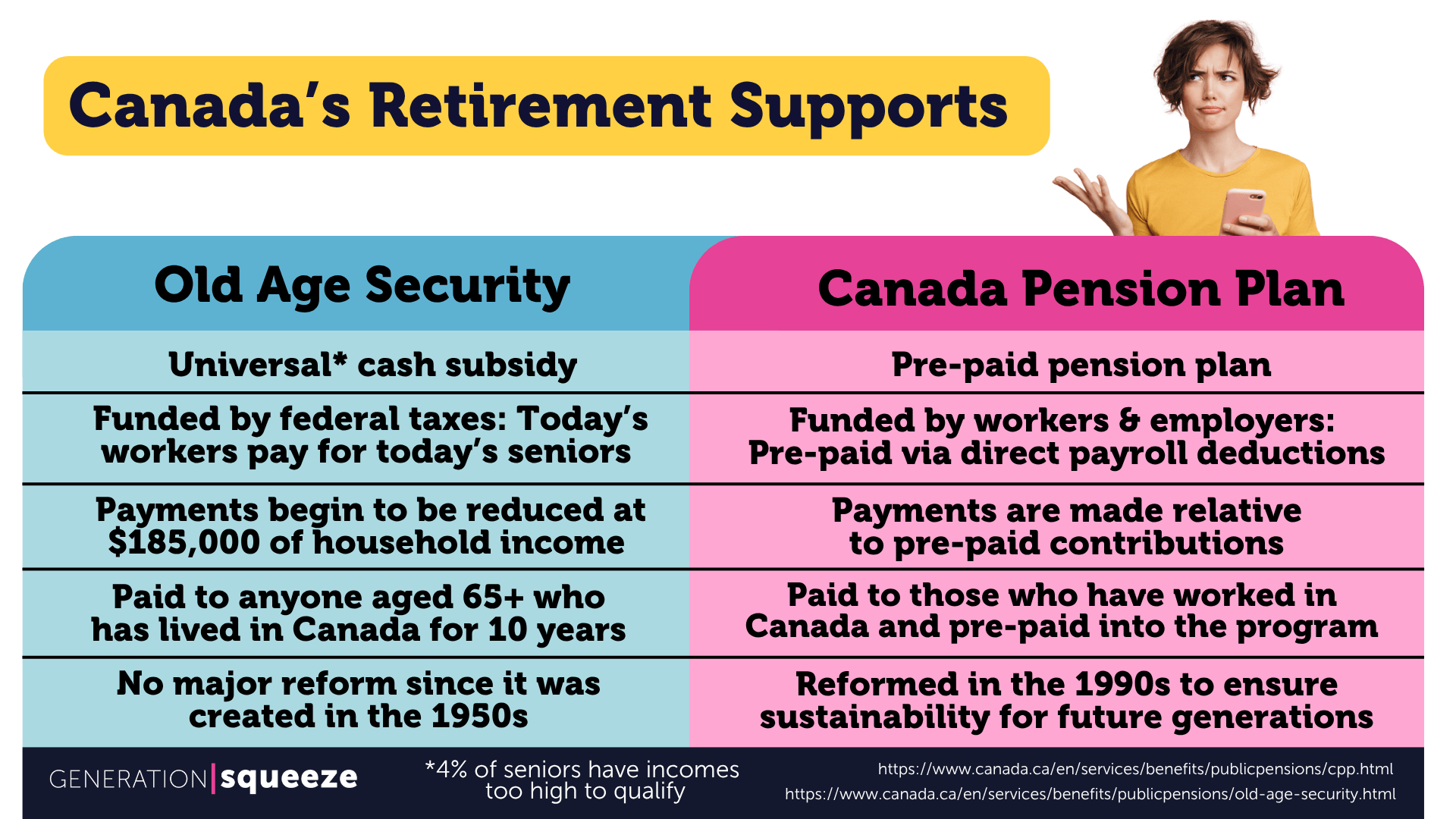
Unlike the Canada Pension Plan, the money seniors get from OAS is not drawn from contributions they have historically made to the program. In other words, they have not 'pre-paid' for the benefits they receive. Instead, OAS is funded out of general government tax revenues, and is paid for by today’s taxpayers.
Under Canada’s current tax system, all Canadian seniors are also automatically eligible for the Pension Income Credit, and those with incomes up to $92,000 are also eligible for the Age Credit. These credits do not benefit the lowest income seniors.
When OAS was created in 1952, things looked pretty different in Canada. We didn't have the Canada Pension Plan. We didn't have as many tax shelters for retirees, like the Age Credit and the Pension Income Credit. People didn't expect to live for as many years post retirement. And we had 7 working age Canadians paying taxes to help support each retiree - today there are only 3 worker per retiree.
With all of the changes that have taken place between 1952 and today, it's no surprise that we're well past due on updating OAS. A 2024 report from the Auditor General confirmed that Ottawa doesn't know if the program is meeting its objectives. It's time to make sure OAS is fit for purpose in 2025.

It is easy to confuse Old Age Security (OAS) and the Canada Pension Plan (CPP) but these two retirement supports don't work the same way. Today’s retirees have not paid into OAS in proportion to the benefits they now receive – even if they worked hard and paid taxes according to the rules of the day. That's because OAS is not a pre-paid pension like the the Canada Pension Plan (CPP). It is a social safety net funded by the Canadian government through taxes. Todays workers pay for todays seniors.
In anticipation of the baby boom cohort aging, the government changed CPP in the 1990s so Canadians could collect a benefit relatively proportionate to what they contributed. Sadly, Ottawa didn’t do the same for OAS. It remains a government subsidy paid to whomever is eligible – and eligibility rules are far more generous than for most other cash benefits. Only 4% of retirees have incomes too high to qualify for the benefit. The generosity of OAS for affluent retirees is now a primary reason we leave 400,000 seniors in poverty, and rack up large deficits that our kids and future generations will inherit.
Our plan would affect the 1 in 5 retirees with household incomes above $100,000. We’re asking them to take about $3,000 less from OAS per year - so that we can give more to those who don't enjoy this level of financial security.
If you think shifting OAS eligibility from $182,000 of household income to $100,000 would create financial hardship for seniors, think again. Seniors who would be personally affected by this change are telling us that it wouldn't have a big effect - and that they'd welcome seeing these funds go towards those who really need more support. You can also take a look at stories of seniors with millions in assets collecting OAS - they are profiled regularly in the Globe & Mail’s Financial Facelift column.
An OAS threshold of $100,000 isn't stingy. It's still more generous than the $81,000 cut-off for the Canada Child Benefit, and is also well above Canada's median family income of $74,000.
After OAS, the Canada Child Benefit (CCB) is likely the best-known cash subsidy delivered by Ottawa. Families receiving the CCB don’t benefit from the same level of generosity extended to retirees.
Ottawa begins reducing the Canada Child Benefit when household income surpasses $81,000. By contrast, retired couples can have $186,000 in combined income before OAS payments are reduced. This disparity persists even though compared to young families, retirees have the lowest rates of poverty, the highest levels of wealth, and a great deal of housing security (since 70% are home owners).
Sadly, fewer than half of Canadians are aware that low-income families with kids receive smaller cash benefits than retirees. Younger age groups are somewhat more likely to be aware of the discrepancy, but just 31% of Canadians ag 65+ know that the cash benefits they receive exceed what’s available to families with kids.

OAS is the largest line item in the federal budget. Nearly one-fifth of all federal spending goes to OAS, and this amount is growing faster than most other expenditures put together.
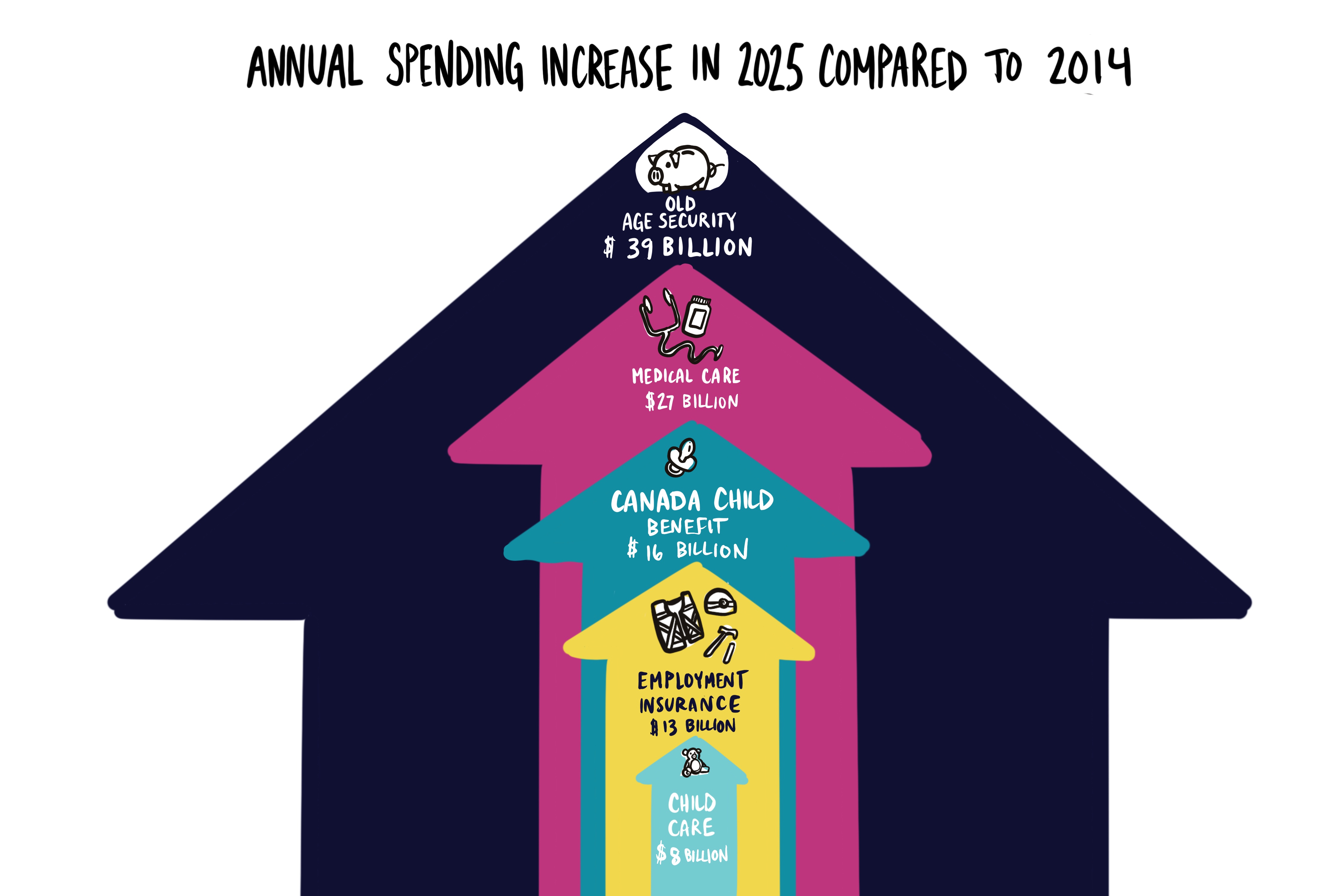
It is impossible to restore balance to the federal budget without factoring in OAS. Politicians who say otherwise are trying to pull the wool over your eyes. There may be other things to cut – and reasonable people can disagree about what these are – but most are simply not big enough ticket items to fill our growing budget hole.
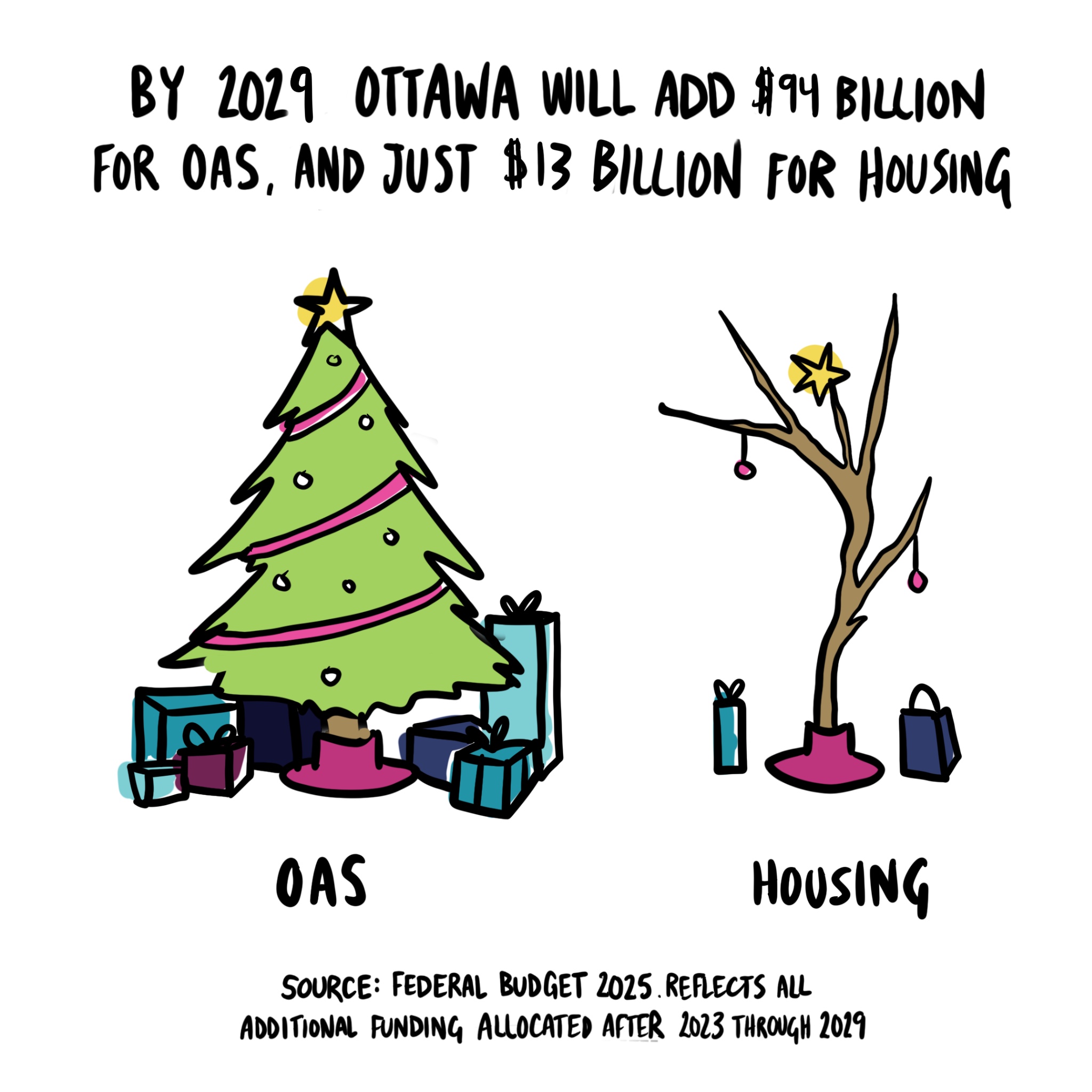
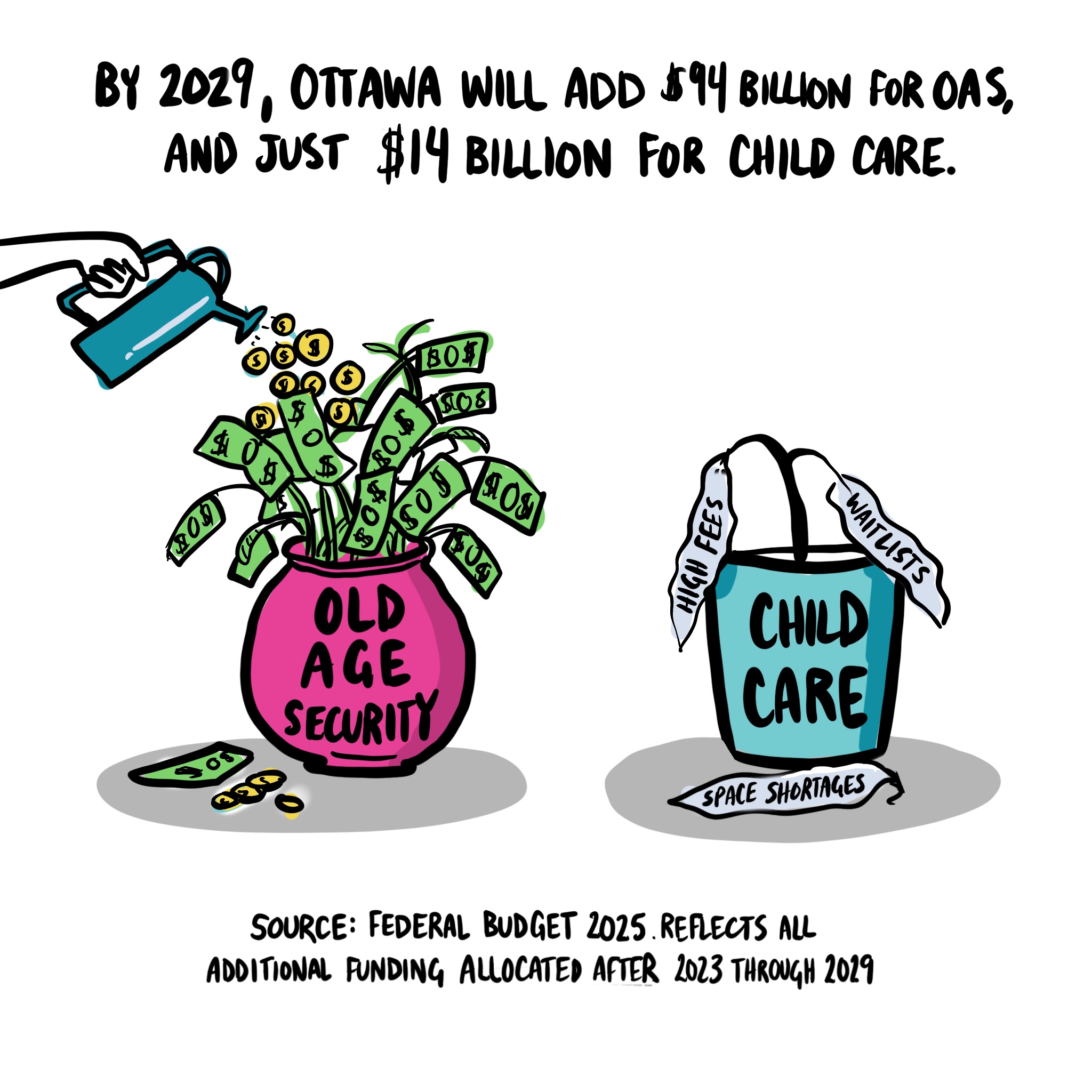
Liberal, Conservative and NDP governments across Canada are running large deficits. This trend is a threat to generational fairness, because younger and future generations will be saddled with the bills we leave unpaid today. To help understand why this is happening, we took a look at how income taxes have changed over the last 5 decades. Here’s what we found.
Because income tax rates are generally lower now than they were half a century ago.
Despite lower tax rates, more tax dollars go to retirees’ medical care and Old Age Security today than half a century ago. This is because the percentage of Canada’s population over age 65 has increased from 8% in 1976, to 19% in 2024.
The typical 35-year-old now pays around 20-40% more for boomers’ Old Age Security and medical care than boomers paid as young people to support the smaller number of seniors in their day.
Together, these trends result in governments having fewer funds to invest in younger generations — even though these age groups face greater financial insecurity and declining wellbeing. That’s not investing fairly in young and old alike.
Learn more in our full tax trends analysis.
The Guaranteed Income Supplement (GIS) is a component of Canada’s Old Age Security (OAS) system that delivers additional non-taxable financial support to retirees with low incomes.
As of May 2025, single retirees with incomes below $22,056 are eligible to receive the GIS. Retired couples are eligible if their combined income is below:
The figures we use on federal government spending on OAS includes spending on GIS.
Our plan to eliminate seniors’ poverty could be implemented by increasing GIS benefits. At present, eligible single retirees can receive up to $1,087 per month, or $13,044 per year. The $5,000 increase we propose would increase this amount by over 38%.
When it comes to measuring seniors' poverty, there are 3 different measures. Two of these 3 show that seniors are less likely to be poor than other age groups. This includes Canada's official poverty measure, which informs the national poverty reduction plan. One measure shows that seniors' poverty is slightly higher than other age groups. No poverty measure accounts for wealth - like the housing wealth that many of the majority of seniors who own their homes have gained from rising prices.
Canada’s official poverty line is the Market Basket Measure (MBM), which defines poverty based on the cost of a ‘basket’ of goods and services considered essential to have a modest standard of living. A household is considered poor if its income is insufficient to purchase this basket. The MBM is measured and reported by Statistics Canada.
According to the MBM, seniors have the lowest rate of poverty of all age groups. The most recent data for 2023 show that seniors are the only group for whom poverty has declined, to 5%.
The Material Deprivation Index (MDI) assesses whether a household can access 11 essential goods and services considered necessary for a ‘minimally acceptable’ standard of living. A household is considered poor if it cannot afford two or more of these 11 items. This measure was developed recently by Food Banks Canada and other partners.
According to the MDI, seniors have the lowest rate of poverty of all age groups. The 14% of seniors considered to be poor under the MDI is much higher than the 5% under the MBM.
The Low Income Measure (LIM) assesses poverty by comparing households to Canada’s median income. It is a relative measure of poverty, meaning that changes to median income can affect the number of households considered poor, even if the incomes of these households themselves remain the same. The LIM considers a household to be poor if its income is less than 50% of the median (adjusted for household size). The LIM is measured and reported by Statistics Canada.
According to the LIM, seniors have slightly higher rates of poverty than other age groups: 13.8% in 2023, compared to 13.2% for those under age 18 and 11.1% for those age 18-64.
The OAS reforms we propose would only impact financially secure senior couples with annual incomes between $100,000 and $300,000. There would be no change in OAS subsidies for retired couples with lower incomes, and some single seniors would receive higher OAS subsidies.
Right now, taxpayers send $14 billion every year to retirees with annual incomes above $100,000, while other seniors, families, and working adults live in poverty. That’s not a responsible use of public funds, and it’s inconsistent with Canadian values about helping those in need.
The original goal of OAS was to ensure that no senior lived her final years in deprivation – a laudable commitment to which we should live up. Yet today, the affluence of some retirees who collect OAS is on display every week in financial advice columns. OAS clearly has drifted too far from its aim. The reforms we propose are urgently needed to restore the integrity of this cornerstone of income security in Canada.

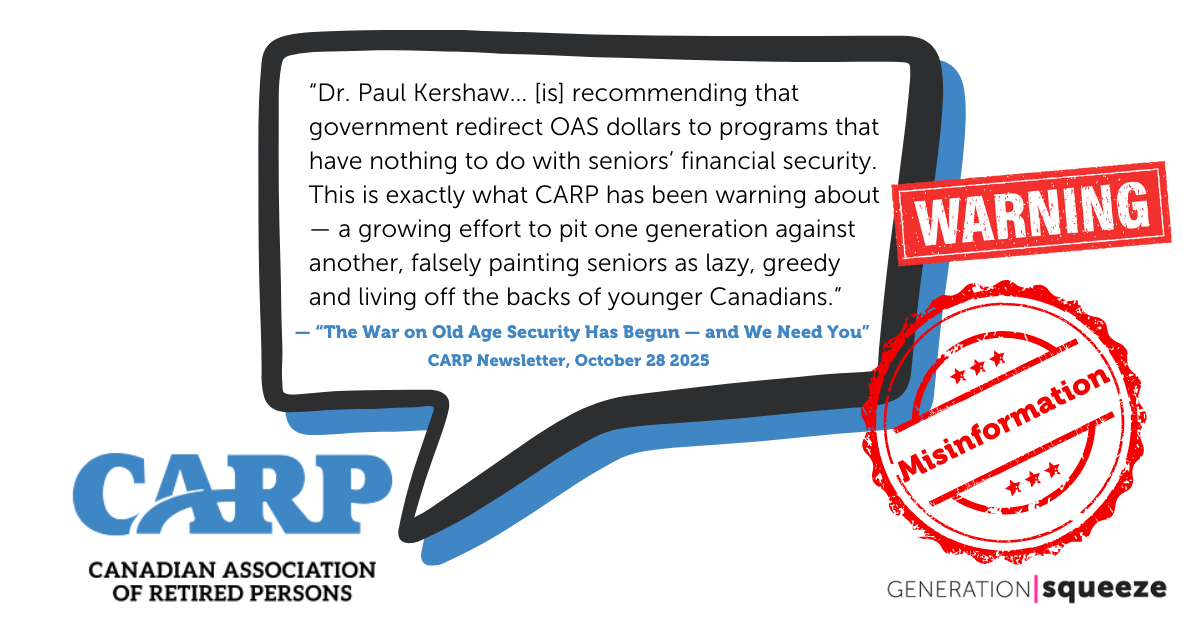
The Canadian Association of Retired Persons (CARP) is pushing to spend another $3 billion a year expanding subsidies for all retirees aged 65-74 – regardless of income or financial security – instead of backing a concrete plan to eliminate seniors’ poverty by making OAS responsible, modern, and fair.
The approach CARP favours offers too little help where it’s needed, and too much where it’s not. Retired couples with millions in assets – the very ones regularly profiled in the Globe & Mail’s Financial Facelift series – do not need larger cheques from Canadian taxpayers. Yet CARP continues to spread misinformation about our plan, overlooking that at the core of our proposal is a commitment to eliminate seniors’ poverty while building a fairer, more sustainable system for future generations.
Canada has a proud history of supporting those in need – systems we’re grateful today’s seniors helped to build. The ongoing success of these systems depends on spending tax dollars wisely, efficiently, and in line with real needs.