What you need to know about lead risks from small planes

-
Lead is toxic - especially for our kids
The scientific evidence that lead is harmful to our health is extensive and longstanding. Lead exposure is particularly dangerous for kids because even low levels can negatively affect brain development. As the administrator of the US Environmental Protect Agency (EPA) stated in 2023: “The science is clear: exposure to lead can cause irreversible and life-long health effects in children.”
The risks of lead are the reason why this dangerous neurotoxin was banned in Canada from paints in the 1960s, car gasoline in 1990, and toys in 2018. Even commercial jets have long operated without leaded fuel. The removal of lead from gasoline is considered a major global public health victory which sparked dramatic decreases in blood lead levels around the world.
Small planes burning leaded fuel remain the "dominant" source of lead emissions in the US — a fact that prompted the EPA to conclude that "lead emissions from aircraft are an important and urgent public health issue" because they "may reasonably be anticipated" to threaten public health and welfare.
Health concerns around leaded aviation fuel intensified following research on a California regional airport which found that children living closest to it had significantly higher lead levels in their blood, especially those living downwind and during periods of heavier aircraft activity.
Continuing to permit small aircraft to burn leaded fuel over communities across Canada is like scattering millions of toys with unsafe lead levels across the places where our children live and play. That's not a risk that parent or family would take, and it's not a risk that local, provincial, and federal governments should continue to permit.
-
Lead risks from small aircraft are growing
The need for action is becoming more urgent because activity at many regional airports is increasing.
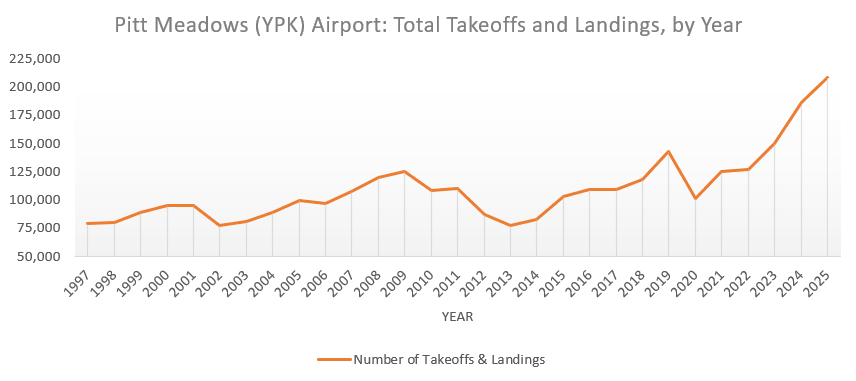
Consider the Pitt Meadows Airport in Metro Vancouver. According to Statistics Canada data, annual aircraft movements surpassed 208,000 in 2025, about twice the level recorded a decade earlier. In practical terms, that growth means an additional aircraft movement every few minutes throughout the day, increasing the volume of lead emissions released into surrounding neighbourhoods.
Pitt Meadows recorded 17,906 takeoffs and landings in June 2026 alone (the most recent data available). That is comparable to the monthly flight activity at Calgary and Montréal's international airports and greater than the totals recorded in Edmonton, Regina, Winnipeg and Halifax. The difference is those airports are dominated by commercial jets that do not operate on leaded fuel, while much of Pitt Meadows' activity involves small piston-engine aircraft that continue to burn leaded avgas.
AI-assisted estimates produced for academic review suggest that total flight activity at Pitt Meadows may now release roughly 366 kilograms of airborne lead annually. That’s equivalent to burning more than 25,000 car tanks of leaded gasoline a year.
-
Canada is lagging behind on protecting kids from lead
Canada is lagging behind the US when it comes to protecting kids from toxic lead.
The scientific consensus about the harmful impact of lead on children prompted the US to commit to phasing out leaded aviation fuel by 2030, leading the way on new standards to protect all communities from the serious threat of lead pollution from aircraft. This decision demonstrates that regulators, airports, aircraft operators, and fuel suppliers judge that the transition is achieveable.By contrast, Transport Canada has not clarified whether Canada plans to phase out leaded aviation gasoline on a similar timeline, and there is currently no regular monitoring of airborne lead pollution at airports like Pitt Meadows, where small aircraft traffic is increasing.
If Ottawa intends to direct new resources toward regional airports as Prime Minister Carney suggested at the 2026 investment summit, it should ensure those investments support the aviation system of the future rather than perpetuate a dangerous health and environmental exemption from the past.
-
There are alternatives to leaded fuel
The good news is that cleaner alternatives toxic leaded aviation fuel are already emerging.
Canadian flight operators, including Sealand Flight in Campbell River, BC, are also beginning to introduce electric training aircraft that dramatically reduce both fuel emissions and aircraft noise.
At Boundary Bay Airport in British Columbia, Delta-based company Elibird aero is working to establish Canada’s first all-electric flight training operation using battery-powered aircraft.
These developments highlight the choice facing regional airports — many of which are owned by the very municipal governments elected to represent residents exposed to rising risks of toxic lead emissions. Should we permit these airports to continue to expand aviation using a toxic fuel the automotive sector abandoned decades ago? Or should we support them to help pioneer the cleaner, quieter aviation systems of the future?
-
Banning leaded fuel doesn't mean getting rid of regional airports
Banning leaded fuel is not an argument against regional airports. Regional airports create jobs that pay family bills. They provide taxes and important economic benefits for the municipalities that often own them. They support pilot training, facilitate emergency response, and improve transportation connectivity.
The question is whether their future growth should depend on a fuel that was removed from everyday transportation decades ago because of its health consequences.
Canadian families should no longer be asked to subsidize recreational flying and flight training by accepting risks to their kids from growing lead emissions.
Aviation gasoline remains one of the last transportation fuels in Canada that still contains lead. If Ottawa intends to direct new resources toward regional airports, these investments should be tied to supporting airports to make the transition to the cleaner and less risky aviation systems of the future - not perpetuating a dangerous health and environmental exemption from the past.