Sep 23, 2026
Analysis of the 2025 Federal Budget: Who is being asked to sacrifice?
Budget 2025 sidesteps a hard truth: neither the Prime Minister who tabled it, nor the Opposition Leader who critiques it, has found the courage to ask financially secure retirees to share equally in this national moment of sacrifice.

Andrea Long
/November 06, 2025
In the lead-up to yesterday’s budget, Prime Minister Mark Carney repeatedly told us Canada is at a hinge moment, and that we’ll need to sacrifice for the common good.
Opposition Leader Pierre Poilievre also rightly told us that younger Canadians are already doing much of that sacrificing – paying record rents and crushing mortgages amidst bleak job prospects so that many older homeowners can continue to count on inflated property values to fund their retirements.
Yet Budget 2025 sidesteps a hard truth: neither the Prime Minister who tabled it, nor the Opposition Leader who critiques it, has found the courage to ask financially secure retirees to share equally in this national moment of sacrifice.
Mr. Carney’s ambition to serve as nation-builder-in-chief will remain out of reach until this tension is resolved. Watch our bonus budget podcast from the National Press Gallery in Ottawa to learn more from Gen Squeeze Founder Paul Kershaw.
Budget 2025 Doesn’t Disrupt the Ageism Behind Canada’s Deficit
Few numbers were as long-awaited or hotly contested as Budget 2025 deficit projections, with predictions ranging from $65 to over $100 billion – a financial outlook the Parliamentary Budget Officer labelled “unsustainable.”
The numbers are now in. Canada’s deficit is protected to be $78.3 billion this year – and remain at $56.6 billion by 2029. These are massive unpaid bills we’re leaving to our kids and to future generations.
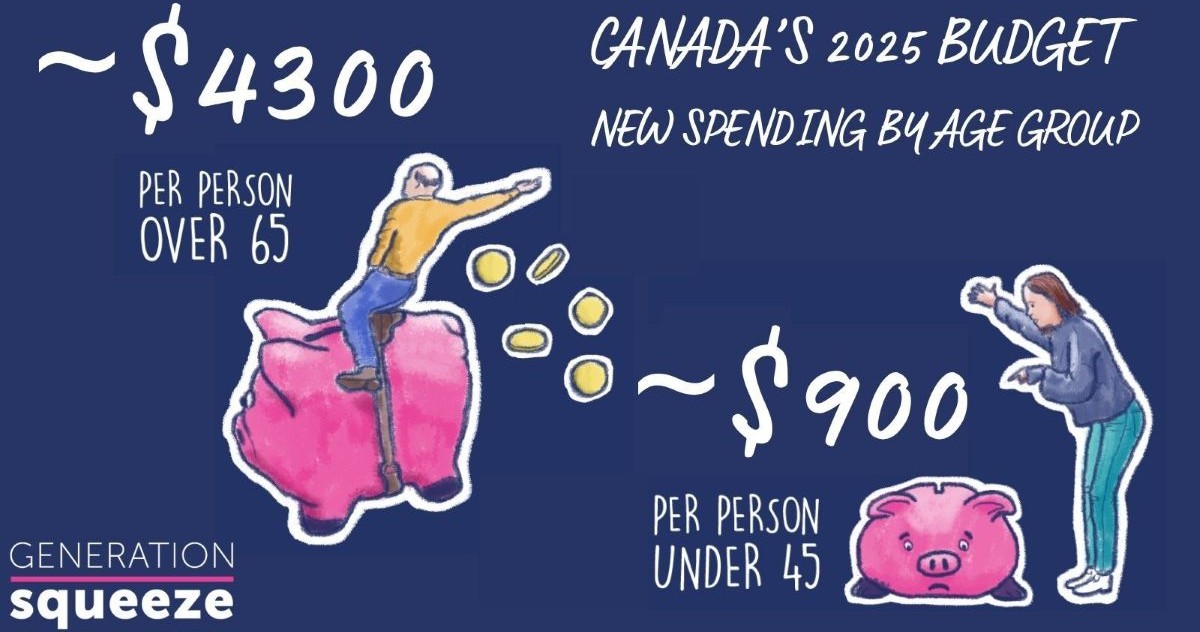
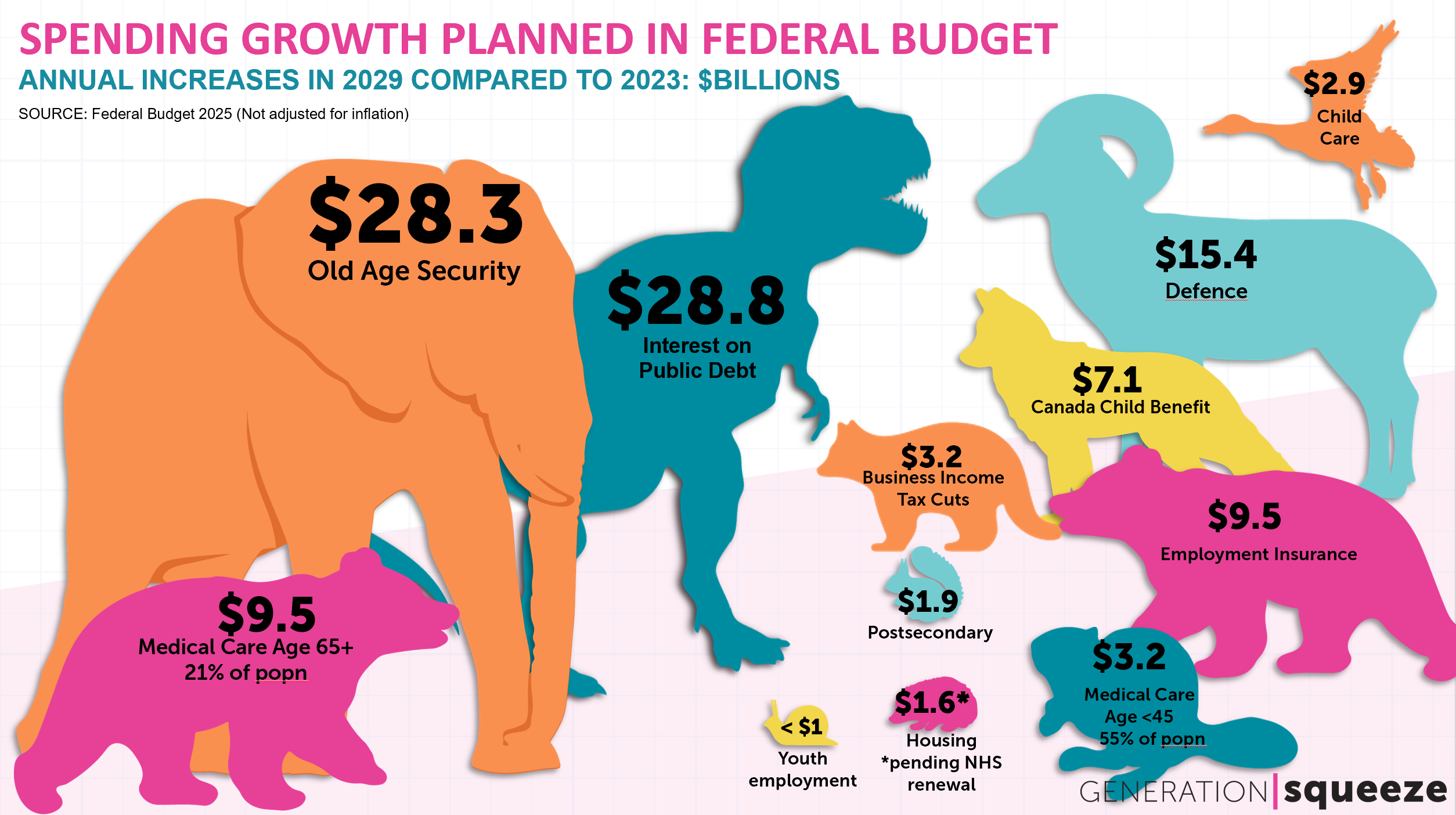
The biggest pressure point is Old Age Security (OAS). It has consumed more new spending than any other program over the past decade — and will take even more in the years ahead. OAS cost $76 billion in 2023, and is on track to hit $104 billion by 2029. That $28 billion increase looms over every other line in the budget.
By comparison, new housing investments grow by only $1.6 billion over the same period, pending renewal of the National Housing Strategy. Child care gets $2.9 billion, postsecondary education $1.9 billion, youth employment under a billion, and business tax incentives $3.2 billion. Even a $15 billion defence buildup can’t compete with the surge in OAS.
Protecting healthy retirements for our aging loved ones is a duty. But the scale of this budget imbalance isn’t just an accounting issue – it’s a moral one.
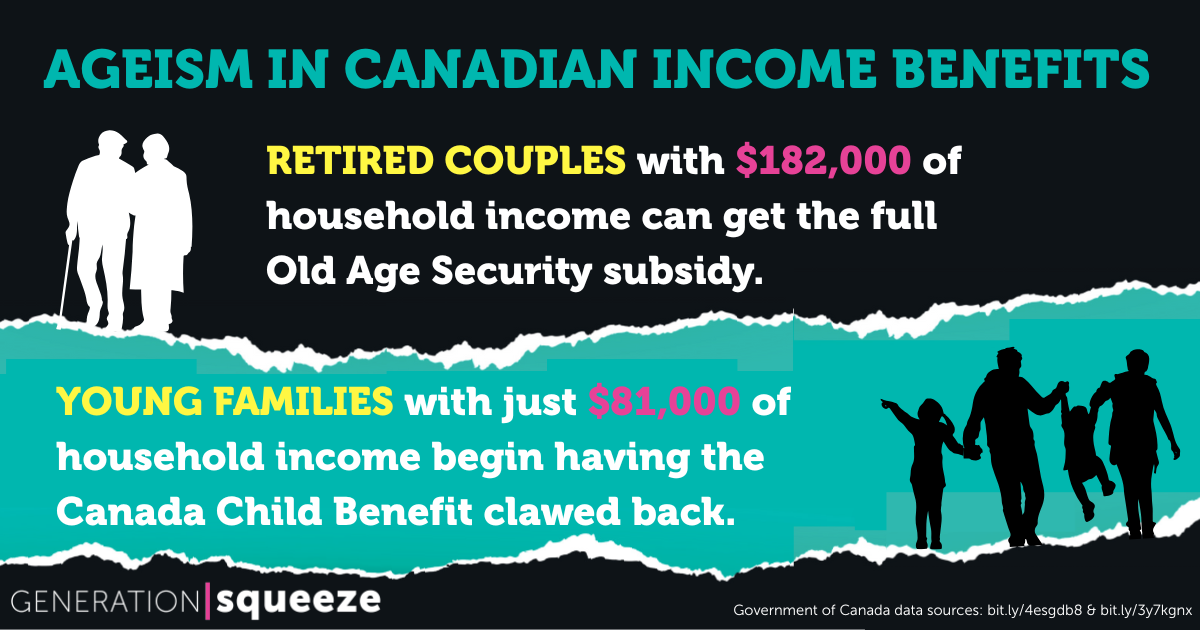
Ottawa continues to ask younger and middle-income families to sacrifice long before it asks the same of financially comfortable retirees. We claw back the Canada Child Benefit at household incomes above $81,000 — but allow OAS to flow until $182,000 per couple. Middle-income parents raising children are asked to tighten their belts while retired couples with six-figure incomes continue to collect $18,000 subsidies.
That is not shared sacrifice. It is structural ageism against young people written into fiscal policy.
The Fiscal Imbalance in Budget 2025 Began a Generation Ago
In the mid-1990s, the Chrétien government warned that Canada’s population would age sharply — with the ratio of working-age people per senior collapsing from seven in the 1970s, to just three today.
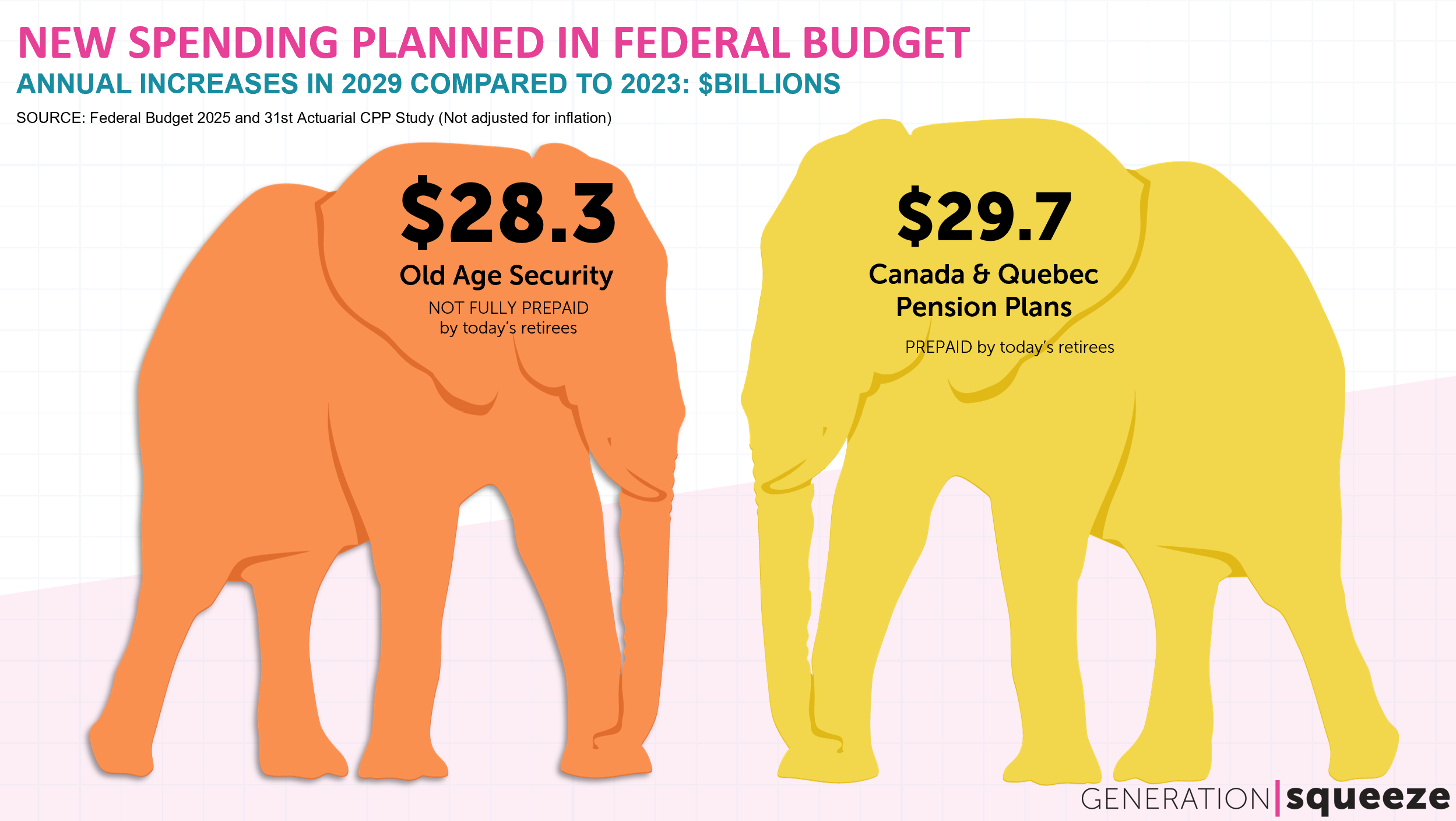
To its credit, Ottawa acted decisively in one area: it increased Canada Pension Plan contributions by nearly 70%. This change asked the baby boom generation to pre-pay enough to cover the benefits they would receive down the road.
Unfortunately, responsible foresight ended there. OAS and medical care were left as is, with no plan to pre-fund the costs of population aging. And as predicted, these costs are now crowding out fiscal space for investments to help younger and working Canadians build homes, raise families, and strengthen productivity. In short, Ottawa made sure big increases in CPP spending would be sustainable – but did nothing to raise the revenue needed to cover similarly big increases in OAS subsidies.
Political leaders have acknowledged this problem. When Pierre Poilievre’s party was last in government, he warned that by the early 2030s “the number of people on OAS will double, the cost will triple, and the number of taxpayers supporting each retiree will fall by half.”
Prime Minister Carney echoed the same warning in his book, Values: “Social-welfare systems designed and enjoyed by previous generations will prove, absent reform, unaffordable for future ones.”
For once, the Opposition Leader and Prime Minister agree on the diagnosis. Now they need the courage to deliver the cure.
The Opportunity Missed in Budget 2025
Retirement policy reform is the gateway to greater income, housing and family security for young and old alike – with no new taxes, and without growing the deficit. Sadly, Budget 2025 neglects this win-win-win opportunity.
Gen Squeeze and others have proposed a pragmatic fix that would eliminate seniors’ poverty, expand affordability measures for younger and working age Canadians, and help restore Canada’s finances: begin reducing OAS subsidies at $100,000 of household income, rather than $182,000 per couple.
This single change would save $7 billion a year, and slow the rapid growth in OAS spending that’s driving up the deficit. It does so while increasing OAS benefits for some single seniors, and leaving the OAS threshold well above median family income, at $74,200.
We propose finding another $7 billion annually by repurposing expenditures on the Age and Pension Income Credits. These two tax breaks largely bypass low-income retirees – an expensive inefficiency Canada can no longer afford. These funds could be better used to offset the rising cost of OAS, as the number of retirees grows.
Why does Budget 2025 leave these costly tax breaks and the unreasonably high OAS threshold untouched? Subsidies for financially secure retirees – some with millions in assets – are being preserved largely because politicians worry that retirement policy reforms will run afoul of well-funded retiree lobbyists pushing to expand OAS for rich and poor seniors alike.
What politicians are failing to adequately consider, however, is how many people across the political spectrum agree that OAS needs updating:
- Retirees are standing up to say that they’re willing to take less from OAS.
- Three-quarters of Canadians support our OAS plan.
- OAS reforms are affirmed by the Globe and Mail editorial board, the publisher of The Hub, and the lead reporter for the National Observer – thought leaders from the right, centre, and left.
- Anti-poverty advocates AND centre-right think tanks concerned with fiscal discipline affirm the need to modernize OAS.
Time to End One-Sided Sacrifice
Budget 2025 remains trapped in a pattern of one-sided sacrifice — the quiet over-extraction from younger and future generations that Mr. Poilievre has rightly highlighted in his “young people have sacrificed enough” speeches.
Not only does most new federal spending flow toward older Canadians, there’s no plan to compensate younger ones for the sacrifices they’re making to protect the housing wealth of those who came before. They’re paying record rents and taking on crushing mortgages — not because of personal failure, but because politicians fear backlash if home values drop substantially.
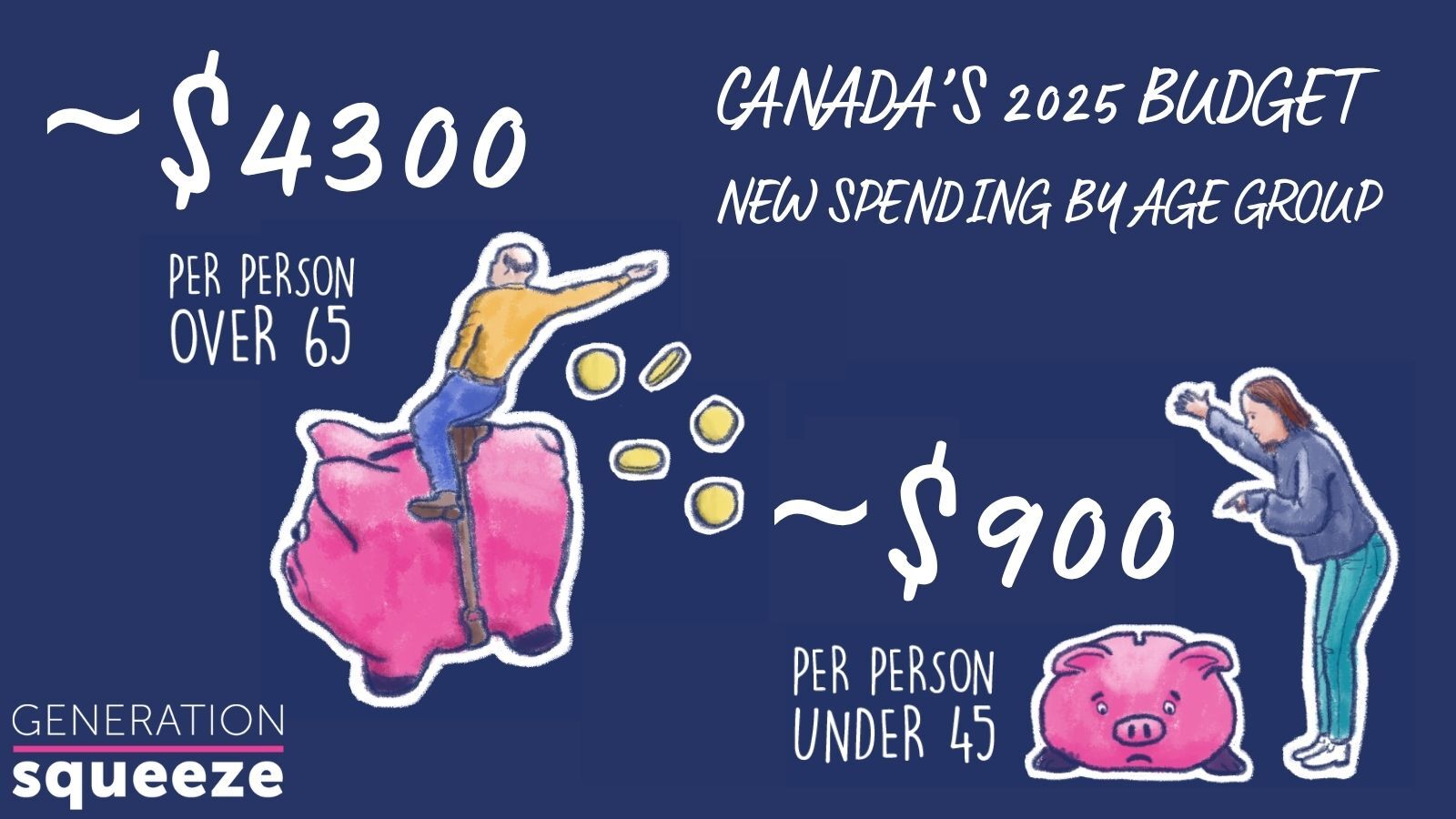
Unfortunately, Mr. Poilievre’s compassion for the sacrifices of young people doesn’t extend to the most consequential form of intergenerational theft: the depletion of the Earth itself. Mr. Carney also delivers little on this front, with a ‘climate competitiveness’ strategy that invests no new dollars in emissions reductions, and cuts funding for several climate-related initiatives. The PM does deserve some credit for committing to strengthen the industrial price on pollution, even the face of Mr. Poilievre’s persistent misinformation about its impact on living costs. We must not betray our kids by expecting them to pay dearly for the pollution Mr. Poilievre would let industry dump for free.
Overall, Budget 2025 fails to acknowledge that younger and future Canadians are being left to shoulder the growing risks and costs of our inaction when it comes to protecting the planet on which they will depend for their lives and livelihoods.
Patience + Vigilance
A fair reading of Budget 2025 should grant the new Prime Minister some latitude. Structural reform is never easy, especially in a minority Parliament. Yet we must be vigilant to ensure that patience does not slip into complacency.
The challenge ahead is not merely to balance the books, but to rebalance the burdens of sacrifice — aligning what each generation gives and gets, and investing where need and productivity returns are greatest.
About Andrea Long
Andrea is the Senior Director for Research and Knowledge Mobilization at Generation Squeeze.
Get Updates
*By clicking "Sign up", you consent to receive periodic updates from Generation Squeeze by email, text and/or phone. You can unsubscribe or text STOP at any time. Message and data rates may apply. Read our privacy policy.