Budget 2025 promises historic action on housing. But buried in the fine print is a surprise. Ottawa's present plans will shrink capital investments for housing in the coming years.
Here’s what you need to know.
There are three key parts of the budget that describe housing funding changes:
1. Capital measures to grow the housing stock (pp. 290–291)
This section is alarming — and should have the PM’s team on it immediately. It shows capital investment in housing will fall from $4.0 billion in 2023 to just $3.35 billion in 2029. That’s the opposite of what Canadians expected from a “housing-focused” budget.
To be fair, Budget 2025 adds a short-term bump in capital spending between 2025–27. But after that, funding tied to the National Housing Strategy ends. This funding cliff creates a serious risk unless Ottawa renews and strengthens the Strategy in the months ahead.
2. Eliminating GST for first-time home buyers (p. 177)
This change adds $1.1 billion more in 2029 — a welcome boost for the shrinking share who can dream of ownership.
3. “Generational infrastructure investments” (p. 123)
Senior Finance officials confirmed this budget line includes $1.2 billion to offset municipal development-cost charges (DCCs) that builders would otherwise pass to buyers or renters.
Total math: – $0.65 billion (drop in capital) + $1.1 billion (GST removal) + $1.2 billion (DCC offset) = $1.6 billion in net new housing spending in 2029 compared with 2023.
It’s hard to call $1.6 billion a “generational investment” when the same budget plans to boost spending on retirees by $28 billion in 2029 alone — billions of which will flow to couples with six-figure incomes and millions in assets.
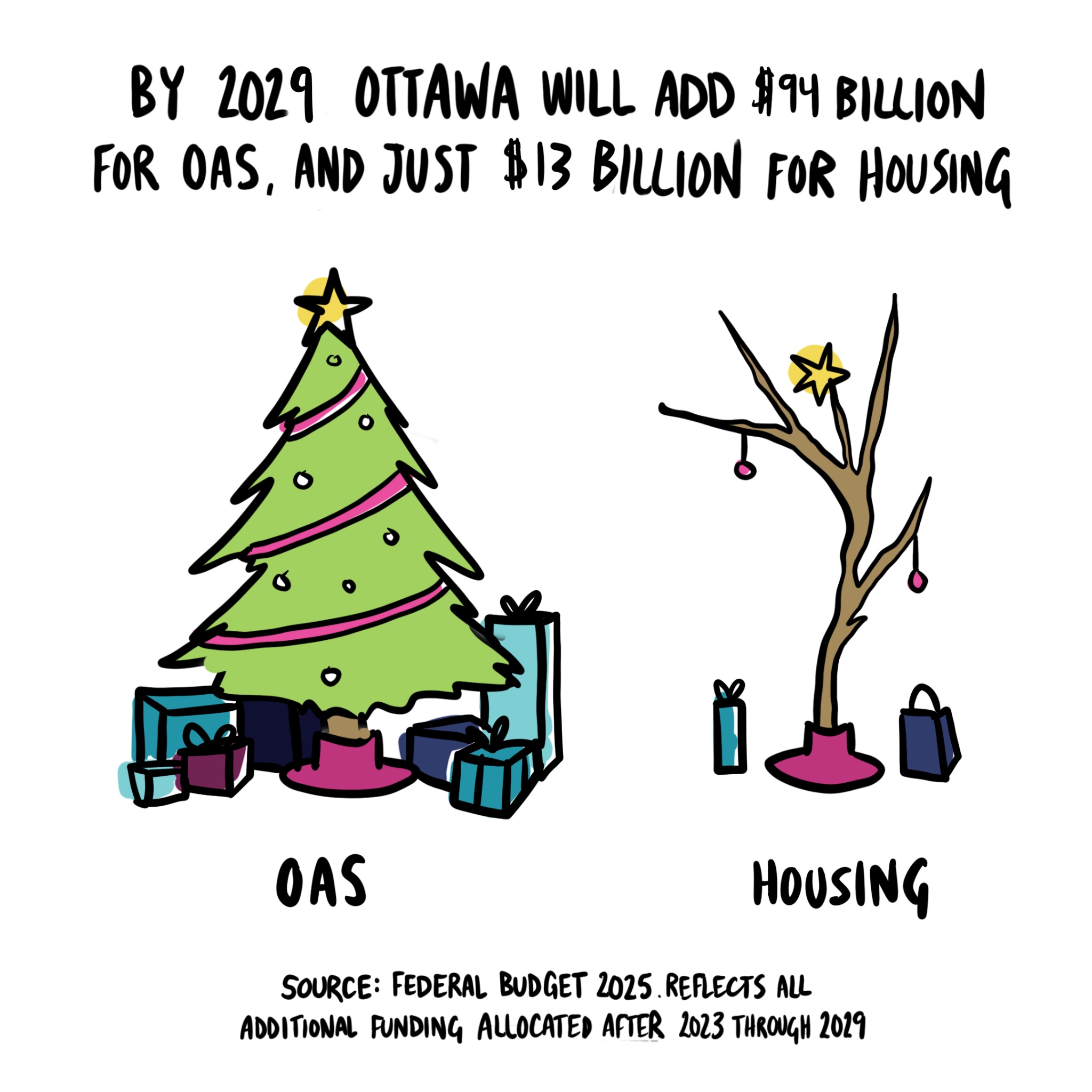
And when you add up all the increases between 2023 and 2029, a profound imbalance remains. Ottawa will spend $94 billion more on Old Age Security, but just $13 billion more on housing.
That gap speaks volumes about where federal priorities really stand in Budget 2025. Check out our budget analysis for more.