Sep 23, 2026
Analysis of the 2026 Ontario Budget
A familiar story is taking hold across Canada. Provinces point to global uncertainty, trade tensions, and economic headwinds to explain rising deficits. These challenges are real, but the fine print in Ontario’s 2026 budget tells a different story.
Andrea Long
/March 27, 2026
A familiar story is taking hold across Canada. Provinces point to global uncertainty, trade tensions, and economic headwinds to explain rising deficits and strained public services.
These challenges are real, but the fine print in Ontario’s 2026 budget tells a different story — one repeated in jurisdictions across the country.
Ontario failed to adequately prepare for the predictable costs of population aging
Ontario’s large provincial deficit isn’t primarily the result of recent economic turbulence. It is the predictable consequence of a policy failure decades in the making: not preparing for the rising medical costs that come with population aging.
Here’s the clearest way to see it in the latest budget tabled by the Ford government.
If Ontario’s population still looked like it did when baby boomers were young — with just 9% of residents over age 65 in 1976, compared to 19% today — the province would be spending $26 billion less on medical care.
Why? Because data from the Canadian Institute for Health Information (CIHI) consistently show that Canadians over age 65 use roughly four times as much medical care as those under 50. As the population ages, costs rise accordingly.
This single demographic shift would turn Ontario’s projected $12.3-billion deficit into a $13.8-billion surplus – without changing any other budget line item.
The same pattern holds across the country, for all major political parties.
In British Columbia, the David Eby NDP government ran a $9.6-billion deficit in 2025. If the province still had the age profile it did when boomers were young — about 10% over 65 instead of roughly 20% today — $8.5 billion of that deficit would disappear.
In Alberta, Danielle Smith’s Conservative government would be spending more than $6 billion less on medical care this year if just 7% of residents were over 65, as in 1976, rather than 15% today. That difference alone would wipe out roughly two-thirds of Alberta’s deficit.
And in New Brunswick, under Liberal premier Susan Holt, the story is the same. If the province still had the age distribution it did in the mid-1970s, it would be spending about 31 per cent less on medical care. Without changing anything else, that shift would turn its $1.4-billion deficit into a modest $100-million surplus.
The real issue is not that this fiscal pressure exists. It’s that governments failed to adapt their revenue systems and spending priorities — even though the timing and scale of population aging were entirely predictable.
As provinces permit medical costs to accumulate, deficits are increasingly used to close the gap. The result is a growing unpaid bill left to younger generations, alongside underinvestment in the priorities that matter most for Millennials, Gen Z, and their children.
Ontario protects investments in services that matter most to seniors, while allowing spending to erode for other age groups
The above context is essential for understanding the spending choices in Ontario’s latest budget.
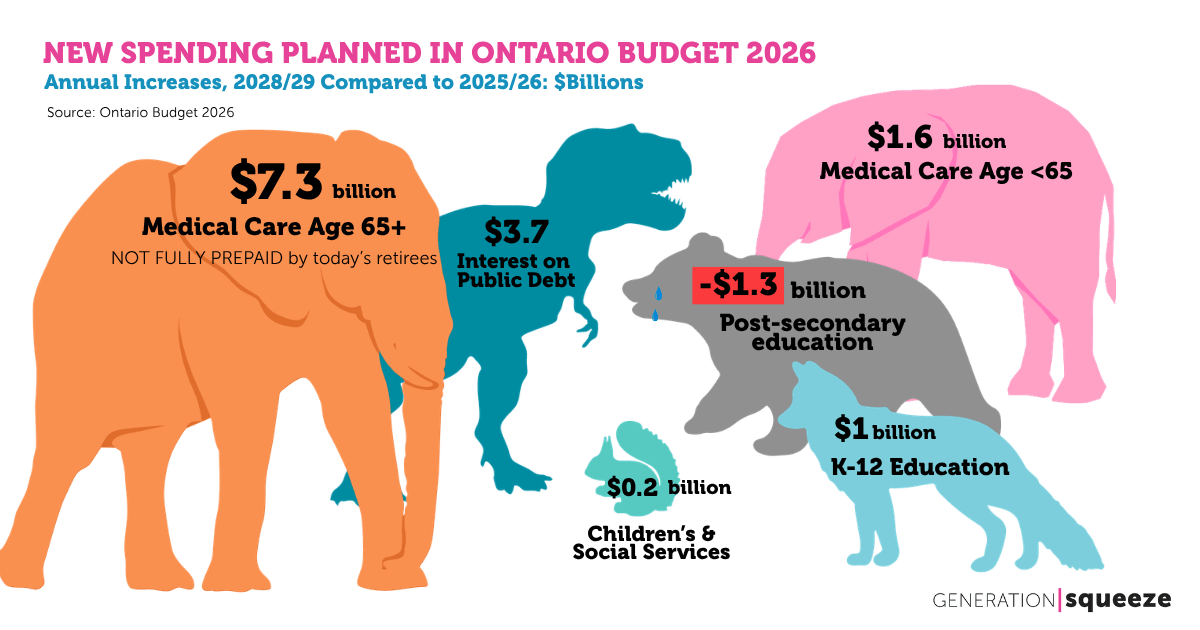
By 2028/29, annual medical care spending in Ontario will increase by another $8.9 billion. CIHI data on health spending by age reveals that roughly $7.3 billion of that increase will go toward those over 65.
Meanwhile, investments in the building blocks of a healthy society for younger Ontarians lag far behind. K-12 education will rise by $1 billion. Postsecondary education will be cut by $1.3 billion. Children’s and social services will barely change, increasing by just $200 million.
When these major spending decisions are broken down by age, Ontario’s 2026 budget adds roughly $2,200 per person age 65 and over, compared to about $100 per person under 45.
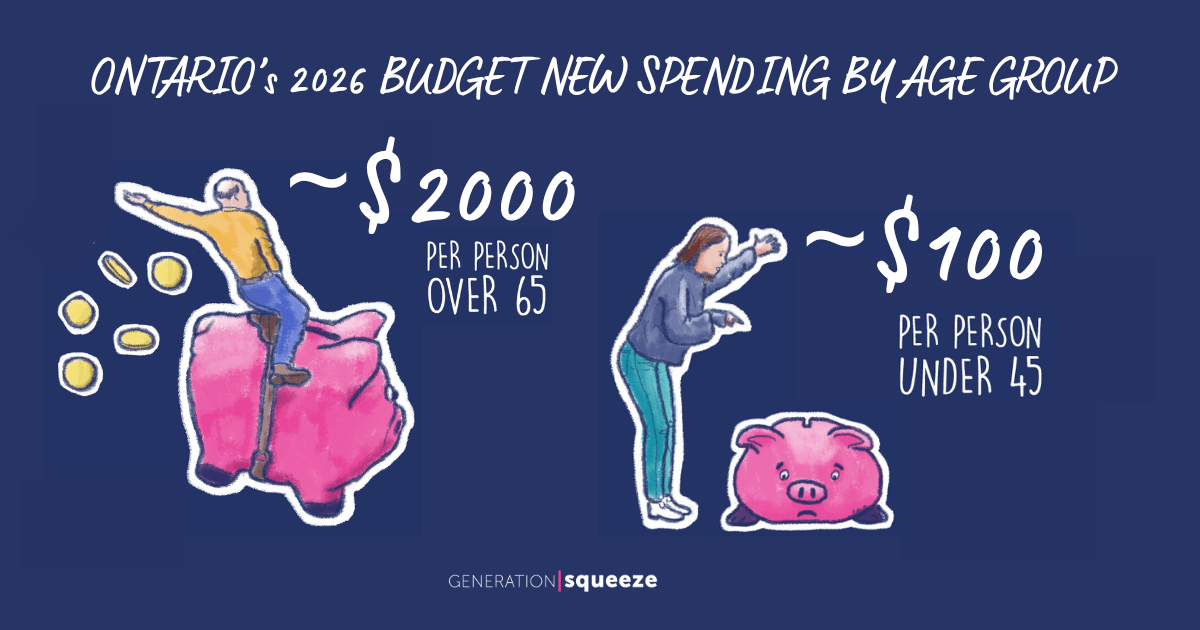
No grandparent I know would choose to spend twenty times more on themselves than on their children and grandchildren. So why does the Ontario government?
I don’t understand how Premier Doug Ford’s cabinet justifies adding $7.3 billion for boomers’ medical care while cutting support for their grandchildren’s postsecondary education.
This isn’t about blaming older Ontarians. No one should be surprised that people need more medical care as they age. That’s a success story — one that reflects longer lives and medical progress.
But Ontario (and other provinces) have yet to meaningfully confront the hard question this success raises. How should we pay for the care we always knew boomers would need? The answer lies in how we faced this challenge before — and handled it differently.
A new conversation about revenue – better late than never
In the late 1990s, Ottawa anticipated the fiscal impact of population aging on the Canada Pension Plan and acted accordingly, increasing premiums by roughly 68%. These higher contributions — paid in part by baby boomers during their working years — helped build a reserve so the CPP would remain sustainable as they now draw down their largely pre-funded CPP benefits.
Provinces made no comparable adjustment for medical care.
Instead of preparing for the medical cost increases we knew would accompany boomer aging, provincial governments in Ontario and elsewhere allowed spending to grow without any matching changes in revenue collection — and then turned to deficits to hide the problem.
Which brings us to the choices being made now.
As Ontario continues to expand medical spending to meet boomers’ care needs, we must find politically viable ways to ask the members of this generation to contribute enough taxes to cover the costs — without leaving the bill to younger Canadians. Only then will Ontario be less likely to prioritize spending increases for grandparents while underinvesting in the conditions that help their children and grandchildren build stable, healthy lives.
To put it more bluntly: unless we correct this imbalance, Ontario and other provinces will continue organizing their budgets in ways that are anti-child, anti-parent, and anti-young worker.
Ontario’s 2026 housing budget underscores the problem
The Ontario Ministry of Municipal Affairs and Housing faces a $345-million cut next year, even as housing remains the defining affordability challenge for younger Ontarians.
Some may argue this cut is offset by the one-year decision to remove the HST on newly built homes, intended to stimulate construction of an estimated 8,000 additional units. But at a cost of $2.2 billion, that amounts to roughly $275,000 in foregone public revenue per additional home.
At a time when far more than 8,000 young renters are struggling to afford even modest housing, it’s fair to ask whether this is the most effective use of scarce public dollars.
If we decide this is the right approach, yet more questions are raised. Why is the overall pool of housing investment so small compared to planned increases in medical spending for retirees? Why isn’t direct support for renters also on the table?
These are the trade-offs Ontario’s budget largely avoids confronting.
Across Canada, fiscal decisions made by provincial governments reflect a deeper pattern. Governments are allowing the rising costs of an aging population to crowd out investments in younger generations, while relying on deficits to offset the costs.
This isn’t a partisan problem. It’s a structural one, common now across all provinces and political parties. And it carries a fundamental risk: Canada’s intergenerational policy bargain is wearing thin.
To restore it, we need to be honest about the hard truth that’s driving fiscal challenges —the failure to raise enough revenue to pay for boomers’ medical care — and then make the difficult policy choices previous governments avoided.
The real problem isn’t that population aging is expensive. It’s that we knew it would be — and didn’t plan accordingly.
About Andrea Long
Andrea is the Senior Director for Research and Knowledge Mobilization at Generation Squeeze.
Get Updates
*By clicking "Sign up", you consent to receive periodic updates from Generation Squeeze by email, text and/or phone. You can unsubscribe or text STOP at any time. Message and data rates may apply. Read our privacy policy.